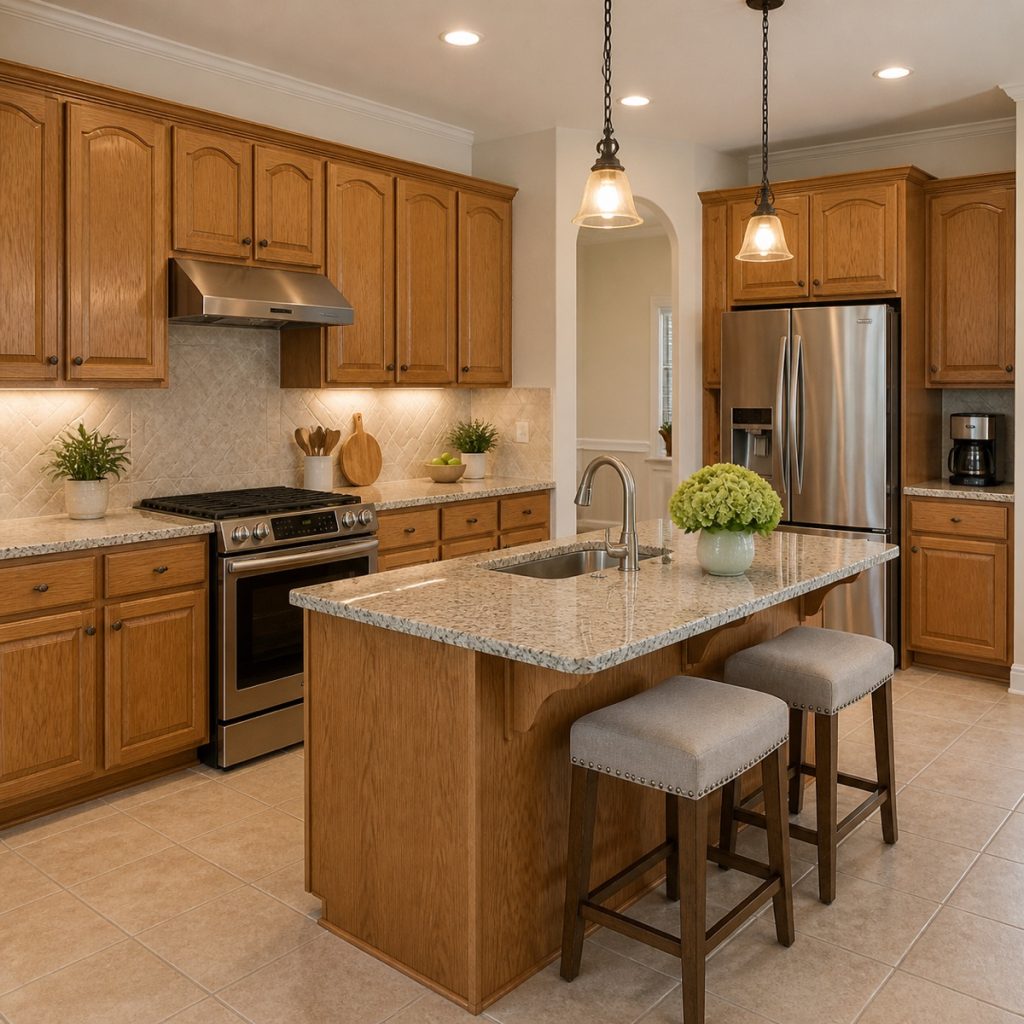
Cabinet planning guide
Builder-grade does not mean disposable. If the cabinet boxes are square, dry, secure, and useful for the way you live, keeping them can be the smartest foundation for a new finish or new doors. If the structure or layout is failing, replacement deserves a serious look.
That distinction matters because homeowners often judge cabinets by the most visible layer: an orange stain, an arched door, basic hardware, or a glossy factory finish. Those details can date a kitchen, but they do not tell you whether the cabinet system underneath has reached the end of its useful life.
Before a proposal is written, ColorUp looks at the condition of the boxes, doors, drawers, hinges, and layout. That condition-first approach separates a cosmetic problem from a structural one and helps avoid paying for demolition that does not solve a real need.
What “builder-grade” actually tells you
Builder-grade is a broad market label, not a diagnosis. It usually means the cabinets were selected to meet the budget and design standards of a new-home package. It does not reliably tell you the cabinet material, the quality of every joint, or how well the kitchen has held up since installation.
Two kitchens built in the same year can age very differently. One may have dry, stable boxes and doors that still align. Another may have swelling around the sink, worn drawer hardware, or panels that have loosened after years of use. The label is the same; the condition is not.
The useful question is therefore not, “Are these builder-grade?” It is, “Which parts are still performing well, and which parts are creating the problem?” That question makes room for a more precise scope.
The short answer
A dated finish is a design issue. Swollen material, loose construction, or an unworkable layout is a cabinet-system issue. They should not automatically receive the same solution.
The condition signals that matter more than the label
A professional evaluation should look beyond the door fronts. Cabinet boxes should feel secure at the wall and remain reasonably square. Shelves and bottoms should not sag under normal storage. Edges near plumbing should not be swollen or soft, and musty odors or active moisture deserve attention before any finish discussion.
Door and drawer behavior matters too. A door that needs hinge adjustment is different from a door whose material is separating. A drawer that needs updated slides is different from a damaged drawer box. Some functional problems can be repaired or upgraded as part of a refresh; others indicate that keeping the existing component would be a false economy.
Layout is the final test. If the kitchen has adequate storage, sensible appliance clearances, and work zones that fit the household, retaining the boxes preserves something valuable. If the refrigerator blocks a walkway, corner storage is unusable, or the family needs an entirely different footprint, a beautiful finish will not correct the planning problem.
How to choose between painting, refacing, and replacement
Keep the boxes
- Painting: best when the layout, boxes, and door style work, but the color or finish feels dated.
- Refacing: useful when the boxes and layout work, but a new door profile would create the larger visual change you want.
Change the system
- Replacement: appropriate when widespread damage, weak construction, major layout limitations, or storage needs justify a new cabinet plan.
Cabinet painting changes the visible finish while preserving the current doors and boxes. It can have a dramatic effect, but it will not erase every trace of wood grain or turn an arched door into a Shaker door.
Cabinet refacing keeps useful boxes while changing the doors and drawer fronts. This is often the middle path when the kitchen functions well but the door style—not merely the color—is what makes it feel dated.
Full replacement earns its place when the kitchen needs more than a surface change. For a broader comparison, read our guide to cabinet painting versus replacement. The right choice is the scope that addresses the actual limitation, not the one with the biggest or smallest headline.
What ColorUp handles during a cabinet refresh
Once painting or refacing is selected, production details belong to the crew. ColorUp handles the removal and tracking of doors and drawer fronts, protection of the surrounding kitchen, cleaning and surface preparation, necessary scope-approved repairs, coating application, hardware coordination, and reinstallation.
The homeowner’s role is simpler: explain how the kitchen is used, identify frustrations worth solving, choose the approved design direction, and prepare personal belongings according to the project handoff. You should not be expected to label hinges, manage the finishing sequence, or supervise technical preparation.
A clear proposal should also explain what will remain usable, where doors are finished, what hardware changes are included, and how the coating cures after reinstallation. That clarity matters as much as the color because it turns a vague renovation into a defined project.
A better way to start the planning conversation
Begin with the outcome you want and the problems you experience every day. Perhaps the kitchen feels dark but stores everything well. Perhaps the boxes are solid, yet the raised-panel doors conflict with the cleaner style used elsewhere in the home. Or perhaps a sink leak has affected one cabinet and you need to know whether the damage is local or part of a larger problem.
Clear, well-lit photos can help start that conversation, but they do not replace an in-person condition check when structure or moisture is in question. In Greater Houston, differences in home age, prior repairs, and remodeling history make assumptions based on neighborhood or build year especially unreliable.
Use our service-selection guide to compare the paths, then ask for a proposal that names what stays, what changes, and why. A useful estimate should leave you understanding the decision—not simply holding a number.
Frequently asked questions
Can builder-grade cabinets be professionally painted?
Often, yes. The deciding factors are surface condition, door construction, box stability, and whether the existing style still suits the homeowner. A professional should evaluate those conditions before recommending a finish system.
Does painting fix damaged cabinet material?
No. Paint changes and protects a properly prepared, sound surface; it does not restore strength to swollen, softened, or separating material. Damage should be assessed and repaired or replaced as appropriate before finishing.
When is refacing a better choice than painting?
Refacing is worth considering when the boxes and layout are useful but the door profile is the main design problem. New doors and drawer fronts can change the visible style while retaining the existing cabinet footprint.
Can soft-close hardware be added during a refresh?
Sometimes. Compatibility depends on the cabinet construction, hinges, drawer boxes, and clearances. The hardware should be reviewed during scope planning rather than promised as a universal retrofit.
How do I know whether replacement is necessary?
Replacement becomes more compelling when damage is widespread, boxes are not secure, the layout creates persistent functional problems, or the desired design requires a new footprint. The condition and planning goals should support that decision.
Find out what is worth keeping
Share your kitchen goals with ColorUp. We will compare the condition, door style, function, and finish options before recommending a scope.
Request a project estimateBy the ColorUp Cabinets team · Published