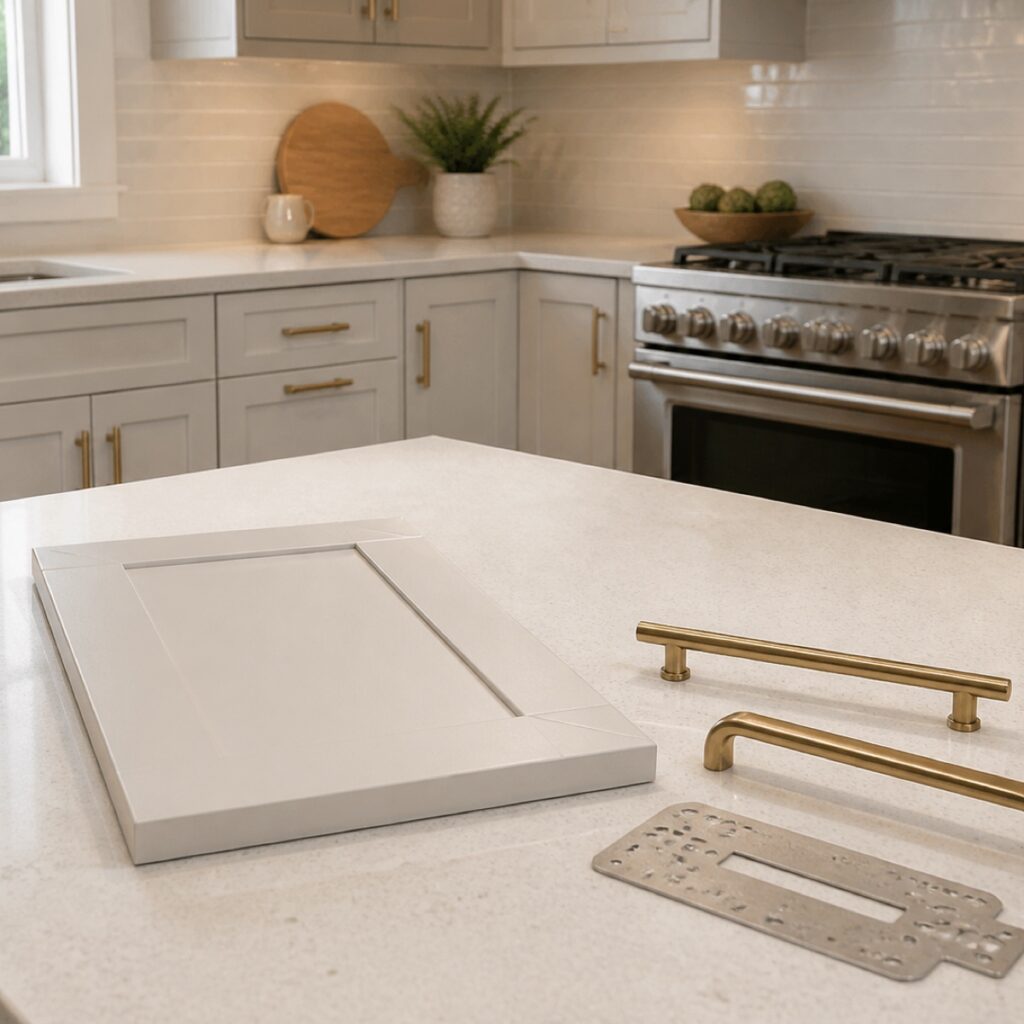
Cabinet hardware planning guide
Choose your cabinet hardware before the cabinets are painted whenever the new pulls or knobs may use different holes. That decision gives the finishing crew time to confirm spacing, repair holes that will no longer be used, and prepare each door or drawer front for the hardware layout you actually want.
Hardware may look like the final decorative detail, but it affects the cabinet surface long before reassembly. A pull with a different center-to-center measurement can leave an old hole exposed. A longer pull may land too close to a door edge. A knob-to-pull change may require a new drilling pattern. These are easier to coordinate before the finish system is applied than after the doors have a completed surface.
You do not need to drill, fill, or label anything yourself. Your role is to select the look and feel you prefer. ColorUp’s crew confirms the hardware plan, tracks the doors and drawer fronts, handles the required repairs and preparation, and installs or coordinates the selected hardware as defined in the project scope.
Why cabinet hardware should be chosen before painting
Existing holes are part of the current door or drawer front. If the new hardware fits those exact holes, the finish process can preserve the layout. If it does not, the unused openings need to be addressed as part of surface preparation. Making that call early keeps the repair, primer, and finish plan aligned with the final design.
Choosing early also helps prevent a second problem: finding a beautiful pull that does not physically work on the cabinet. Projection affects whether doors open comfortably beside walls and appliances. Length affects visual balance on narrow doors. Base width can determine whether an old mark or opening is covered. A sample held against the actual cabinet is more informative than a product photo viewed by itself.
Color determines the background. Hardware sets the scale, contrast, and touch point. Planning them together produces a more intentional result than treating the pulls as an afterthought.
The cabinet hardware measurements that matter
Center-to-center spacing
For a pull, center-to-center spacing is the distance between the centers of the two mounting holes. It is the first measurement to compare when you hope to reuse existing holes. Overall pull length is different and does not tell you whether the screws will align.
Projection and clearance
Projection is how far the hardware extends from the cabinet face. A deeper pull can feel comfortable, but it also needs room near adjacent doors, corner cabinets, appliance handles, and walls. The right choice should allow the kitchen to function without handles colliding or catching.
Door and drawer proportions
A pull can be technically installable and still feel too large or too small. Wide drawers can support a longer pull, while narrow doors usually need a quieter scale. Consistency matters, but that does not always mean using one identical length everywhere. A coordinated family of sizes can create better balance.
| Question | Why it matters before finishing |
|---|---|
| Will the existing holes be reused? | Determines whether repairs and a new drilling layout are needed. |
| Does the pull clear nearby surfaces? | Helps prevent conflicts with doors, walls, and appliance handles. |
| Does the scale fit each cabinet? | Keeps narrow doors and wide drawers visually balanced. |
| Does the finish work with the room? | Connects the cabinet color to the faucet, lighting, appliances, and other metals. |
Should you reuse the old holes or change the hardware layout?
Reusing existing holes is often the simplest path when the current hardware location feels comfortable and the preferred replacement is available in the same spacing. It reduces the number of surface repairs and preserves a layout that already works.
Changing the layout can be worthwhile when the old placement feels awkward, the hardware is undersized, or the new design calls for a different type of pull. It can also help a refaced kitchen feel more considered when the new door profile has different proportions. The important point is to make the change deliberately and include it in the written scope.
Do not choose solely because a product is labeled “standard.” Cabinet hardware comes in many measurements, and older kitchens may not match today’s most common sizes. The actual door, drawer front, and existing holes are the authority.
How to make cabinet hardware feel connected to the kitchen
Finish names such as brass, bronze, nickel, and black are only a starting point. Two products with the same label can have different warmth, sheen, and undertones. Compare a physical sample with the cabinet color and the nearby metals instead of expecting every finish to match perfectly.
A coordinated kitchen does not require every metal to be identical. The goal is for repeated finishes to feel intentional. Hardware may relate to the faucet, pendant lights, range details, or door hardware while still providing useful contrast against the cabinet color.
Greater Houston kitchens often have strong daylight that changes throughout the day. A warm metal against an off-white cabinet can look subtle in morning light and more pronounced under evening fixtures. Looking at the sample vertically on the cabinet face helps reveal its real scale and contrast.
If the project also includes cabinet refacing, select hardware after the new door profile is established but before the finishing and drilling plan is finalized. If the existing doors will remain, the same early decision supports a cleaner cabinet painting scope.
What ColorUp handles during the project
Before production, ColorUp confirms the selected hardware, quantities, hole spacing, placement, and any clearance concerns included in the scope. The crew removes and tracks the doors and drawer fronts, records the cabinet positions, evaluates the old openings, and performs the required surface preparation.
When holes are changing, the crew follows the repair and preparation plan before applying the finish system. After the appropriate finish and cure stages, the doors and drawer fronts are returned, aligned, and fitted with the approved hardware according to the project scope. This keeps production responsibility with the professionals and gives the homeowner one clear decision to make: which hardware best fits the design and daily use.
- Choose the preferred style and finish.
- Let ColorUp confirm spacing, scale, quantity, and clearance on the actual cabinets.
- Approve whether existing holes will be reused or changed in the written scope.
Frequently asked questions
Can I keep my current cabinet hardware?
Yes, when it is in good condition and still fits the design. The existing pieces can be evaluated for cleaning, wear, missing fasteners, and compatibility with the finished cabinet surface.
Can new pulls use the existing holes?
They can when the center-to-center spacing matches and the new base covers the existing opening appropriately. The overall length shown in a product listing is not enough; the mounting-hole measurement must match.
What if I have not selected hardware when the estimate is prepared?
The options can still be discussed, but the final spacing and repair plan should be confirmed before production. A written allowance or clearly defined selection deadline can keep the scope from becoming ambiguous.
Should every drawer use the same pull length?
Not necessarily. Matching hardware families with coordinated sizes can look more balanced across narrow doors and wide drawers. The layout should feel consistent without forcing one scale onto every cabinet.
Can ColorUp help verify the hardware from photos?
Photos and product links can begin the comparison. Final confirmation should use the actual cabinet measurements and the selected hardware specifications so hole spacing, quantity, and clearances are accurate.
Plan the hardware before the finish begins
Send ColorUp photos of your cabinets and the hardware you are considering. We will help you compare the spacing, scale, and finish as part of a practical cabinet update.
Request a project estimatePrepared by ColorUp Cabinets for homeowners planning cabinet painting, refacing, and hardware updates. Updated August 24, 2026.