How Long Does Professional Cabinet Paint Last? (And Why DIY Falls Short)
The difference between an 8-year finish and a 2-year finish comes down to three things: the paint, the prep, and the application method. Here’s exactly what separates them.
Published April 22, 2026 | 8 min read | By the ColorUp Cabinets Team
Home/Blog/ How Long Does Professional Cabinet Paint Last? (And Why DIY Falls Short)
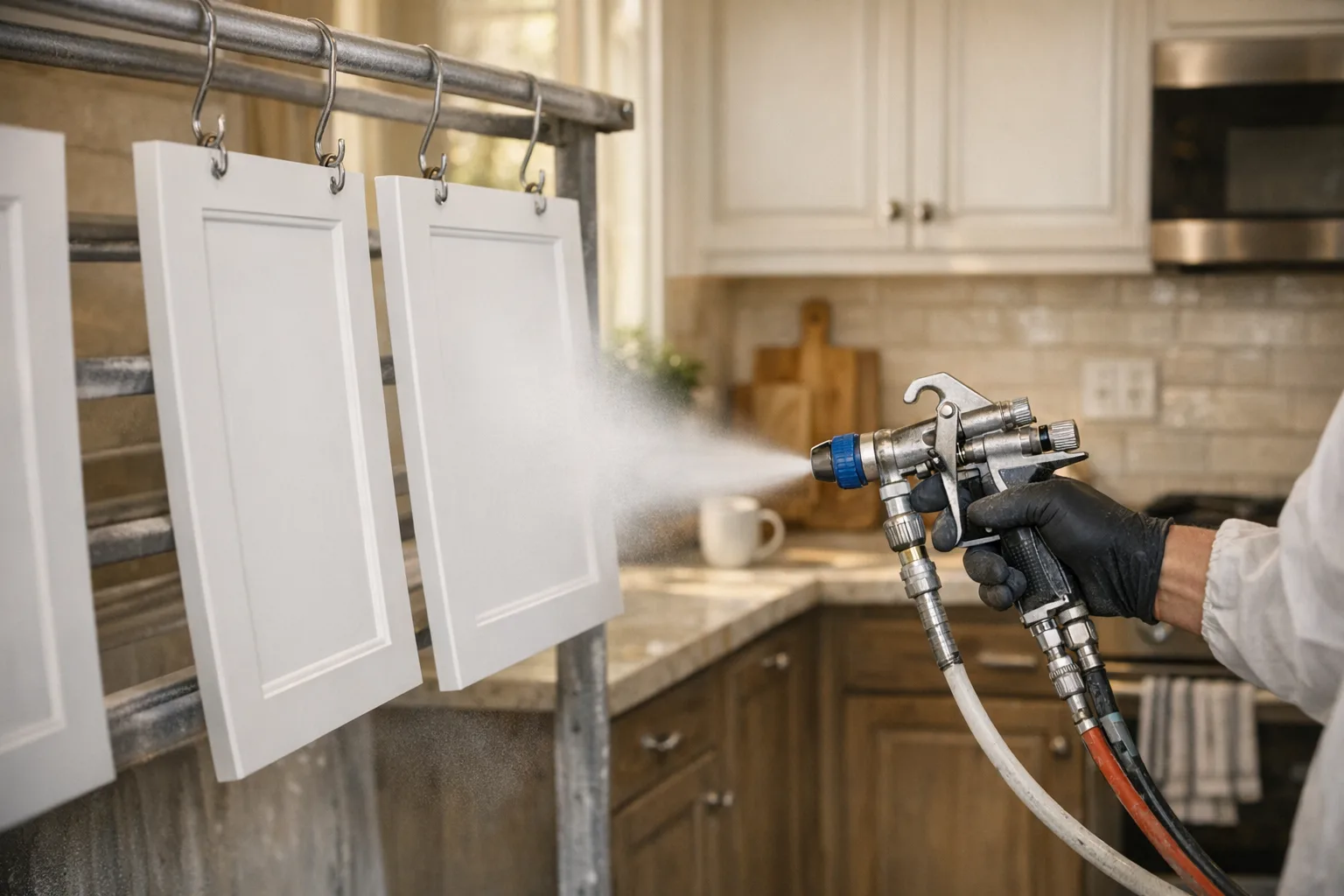
Doors and drawer fronts are removed and sprayed in a controlled facility — part of the preparation and application plan.
The Lifespan Gap: What Determines Finish Life
Most homeowners assume a painted cabinet is a painted cabinet. The finish looks similar at first. Then year two hits.
Professional cabinet paint, done right, lasts a service life that depends on preparation, use, and care. A solid DIY job with good-quality store-bought paint typically lasts a variable service life before chipping, scuffing, or peeling becomes hard to ignore. That’s not a small gap — it’s a completely different product category.
The difference isn’t just skill. It’s chemistry, equipment, and prep. All three have to line up for a finish to hold up through years of Houston kitchen use.
Paint Chemistry: Why the Product Matters More Than the Brand
Walk into any home improvement store and you’ll find paints marketed for cabinets. Some are decent. None of them are what a professional uses.
Choose a cabinet-compatible coating system and follow its preparation and application requirements. ColorUp uses Renner Italian wood coatings; the proposal identifies the system for your project.
Here’s why that matters in your kitchen.
Property
Standard Latex (DIY)
Industrial Polyurethane (Pro)
Cure Hardness
Stays slightly soft
Cures to a hard shell
Moisture Resistance
Low — absorbs steam and splatter
High — repels moisture effectively
Grease Resistance
Moderate at best
High — easy to wipe clean
Chip Resistance
Chips at impact points
Flexes and resists chipping
Yellowing Over Time
Common, especially near stove
Minimal with quality topcoat
Expected Lifespan
Varies with the system and use
Varies with the system and use
⚠️
Don’t Use Wall Paint on Cabinets
Cabinet surfaces need a coating system suitable for frequent handling, cleaning, and the underlying material. Follow the manufacturer’s preparation and application requirements; a product’s use on walls does not establish its suitability for cabinets.
Spray vs Brush and Roller: It’s Not Just About Looks
A sprayed finish looks better than a brushed one — that part is obvious. What most people don’t realize is that it also lasts longer.
When paint is brushed or rolled on, the film thickness varies across the surface. Thin spots wear through first. Brush marks create micro-ridges where the finish can start to peel. Roller texture traps grease and is harder to clean without wearing down the paint.
Spray application — specifically Air Assisted Airless equipment — lays down an even, consistent film every time. The coverage is uniform from edge to edge. That uniform thickness is a big part of why sprayed cabinets hold up so much longer at the high-wear zones.
Brush & Roller (DIY)
Materials depend on the selected system
Uneven film thickness
Visible brush marks and texture
Thin spots wear first
Harder to clean without damaging finish
Service life varies
VS
Air Assisted Airless Spray (Pro)
$3,500–$9,500 for most kitchens
Consistent film thickness throughout
Near factory-smooth finish
Uniform edge-to-edge coverage
Easy to clean without wear
Service life varies
High-Wear Zones: Where Cabinet Paint Fails First
Not all of your cabinets take the same beating. Knowing the weak points helps you spot problems early and protect them during cleaning.
These are the four areas that wear out fastest — in order of how quickly they typically show damage.
Handle & Pull AreasHighest Wear
Daily finger contact + oils from hands — wears finish faster than anything else
Stove-Adjacent CabinetsVery High Wear
Grease mist + heat cycling degrades paint chemistry over time
Dishwasher & Sink AreaHigh Wear
Steam and moisture cause bubbling and peeling on the bottom edge of upper cabinets
Want a Finish That Actually Lasts?
ColorUp uses Renner Italian cabinet coatings with professional spray application. Share your cabinet condition and finish goals to discuss the preparation and scope.
How many years do professionally painted cabinets last?
Finish life depends on the existing surface, preparation, coating compatibility, application, use, and care. A fixed number of years is not a promise for every kitchen. Follow the care instructions and the written warranty for your project.
Do painted cabinets chip easily?
It depends heavily on what paint was used and how it was applied. Brush-rolled latex paint chips relatively easily, especially around handles and door edges. Industrial polyurethane enamels sprayed by a professional are far more chip-resistant — they cure into a hard, factory-like shell rather than staying slightly flexible like latex. High-wear zones like lower cabinets and the area next to the stove are the first places to show wear on any painted surface.
What type of paint lasts longest on cabinets?
Alkyd-modified acrylic enamels and pigmented polyurethane topcoats outperform standard latex by a wide margin on cabinets. These coatings are formulated to cure hard, resist moisture and grease, and hold up to daily opening and closing. ColorUp uses Renner Italia Wood Coatings, an industrial water-based system designed specifically for kitchen cabinetry — not repurposed wall paint.
How do I maintain painted kitchen cabinets?
Use a soft microfiber cloth and a mild dish soap solution for regular cleaning. Avoid abrasive scrubbing pads, Magic Erasers, and anything ammonia-based — these wear down the topcoat faster than normal use does. Wipe up water and grease splashes quickly, especially near the sink and stove. ColorUp provides a touch-up kit at the end of every project so minor scuffs can be addressed before they become bigger problems.
Will painted cabinets hold up in Houston humidity?
Yes — if the right coating was used. Houston’s humidity is real, but the bigger challenge is the daily swing between humid outdoor air and dry air-conditioned interiors. That constant expansion and contraction stresses paint over time. Industrial coatings like Renner Italia are formulated to flex with those changes without cracking. Standard latex paint is not, which is part of why DIY finishes fail faster in Houston than in drier climates.
What is the difference between cabinet paint and wall paint?
Wall paint is designed to be rolled on flat surfaces that barely get touched. Cabinet paint — real cabinet paint — is engineered to cure hard, resist moisture, tolerate daily contact, and hold up to cleaning. Wall paint stays slightly flexible and soft after drying, which means it scuffs, chips, and picks up grease easily. Using wall paint on cabinets is one of the most common reasons DIY projects fail within the first year or two.
How do I know if my cabinets need a touch-up or a full repaint?
Isolated chips, scuffs near handles, or a few worn spots around doors usually mean a touch-up is enough — especially if the overall finish still looks solid. If you’re seeing peeling, widespread yellowing, chalky texture, or paint that’s bubbling near the dishwasher or sink, that’s a full repaint situation. The substrate condition matters too: if moisture has gotten under the paint and the wood or MDF has swelled, a repaint alone won’t fix it.
ColorUp Cabinets serves all of Houston — from Kingwood and The Woodlands to Sugar Land, Katy, and Pearland. We use industrial-grade coatings and a proven process that holds up against Houston heat, humidity, and daily kitchen use. Get your free estimate today.