Cabinet planning guide
The most useful kitchen storage upgrade is usually the one that removes a frustration you repeat every day. Start with the routine—not a catalog of accessories—then confirm that the cabinet structure, clearances, ventilation, and cleaning needs support the idea.
A kitchen can have plenty of cabinets and still feel disorganized. Pet bowls sit in a walkway. Sheet pans are buried beneath heavy cookware. The coffee maker occupies the best prep space because its supplies live in three different places. None of these problems sounds dramatic, yet each one interrupts the room over and over.
That is why good storage planning begins with observation. The goal is not to fit the greatest number of gadgets into the cabinets. It is to give frequently used items a logical home without creating a new collision, a harder cleaning problem, or a feature that becomes inconvenient after the novelty wears off.
Start with the five-minute routine that keeps going wrong
Think about the moments when the kitchen becomes frustrating. It may happen while preparing breakfast, unloading groceries, feeding a pet, putting away clean dishes, or reaching for a baking sheet. The best clue is not a cluttered cabinet by itself; it is the sequence of movements that creates the clutter.
For example, a coffee station works only when the machine, mugs, filters, beans, water access, and waste routine can live together without consuming the main food-preparation zone. A pet station is useful only when bowls stay outside the primary walkway and the area can be cleaned easily. A rollout is valuable when it brings stored items into view without striking an adjacent door or appliance.
Describe the routine in plain language: what you reach for, where you use it, what gets moved out of the way, and where items end up afterward. That story gives a designer or estimator far more useful information than saying, “I need more storage.”
A practical filter
A storage feature should reduce movement, protect a clear walkway, remain easy to clean, and fit the cabinet safely. If it solves one problem by creating another, the plan needs another pass.
Match the storage idea to the actual problem
When items disappear behind other items
Deep base cabinets often hide small appliances, pots, or pantry goods behind the first row. A compatible rollout can improve visibility and access, but the opening width, hinge projection, door swing, and interior obstructions must be checked before choosing hardware.
When flat items become a heavy stack
Sheet pans, cutting boards, and serving trays are easier to reach vertically when the cabinet has enough height and a divider layout suited to the collection. The useful measurement is not simply the cabinet width; it is the size and quantity of the items that need a home.
When a daily activity takes over the countertop
A contained beverage zone or appliance garage may help when it is placed near the right outlets and water source. Small appliances also need appropriate ventilation and usable door clearances. Hiding an appliance is not an improvement if using it becomes awkward or unsafe.
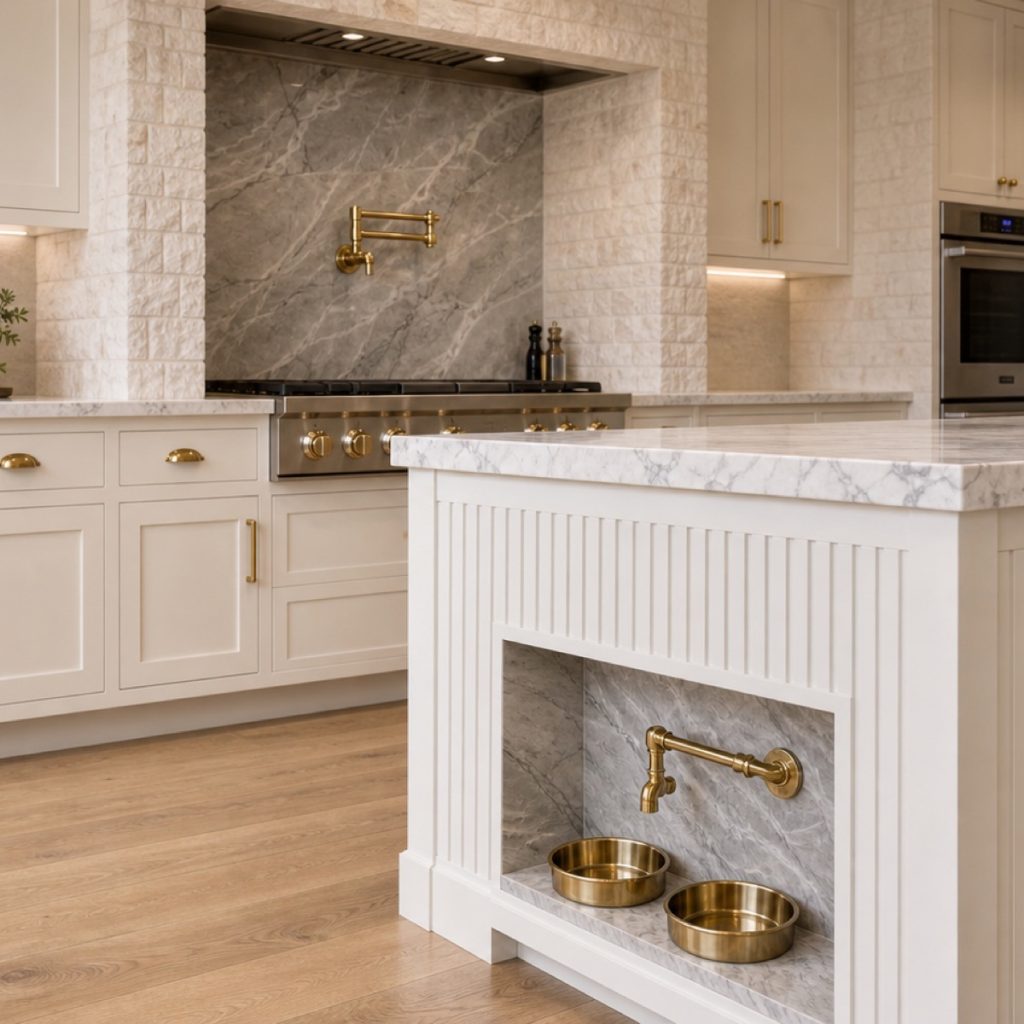
When pet bowls occupy the walkway
A dedicated open niche can move bowls out of foot traffic and make the routine feel intentional. The location should avoid hot appliances, tight corners, and cabinet doors that need the same floor space. Durable, wipeable surfaces matter because the feature must work on an ordinary day, not only in a photograph.
Check structure and clearances before falling in love with the feature
Many storage ideas are possible, but not every existing cabinet can accept every retrofit. Face-frame width, door openings, drawer construction, plumbing, electrical locations, ventilation, and neighboring appliances all influence what will work. An older cabinet may also need repair or reinforcement before it carries new internal hardware.
Door and drawer movement deserves special attention. A rollout can be perfectly sized inside the box and still collide with a hinge or fail to clear a partially opened door. A pullout beside a range must not interfere with handles or heat zones. A feature near a corner should be tested against both cabinet runs, not viewed in isolation.
Cleaning is another design constraint. Narrow gaps that trap crumbs, absorbent materials beneath water bowls, or hardware that prevents easy access can turn a clever idea into a maintenance problem. A successful upgrade should make the daily routine simpler from use through cleanup.
Connect storage upgrades to the right cabinet project
Keep the cabinet footprint
- Selective retrofit: add compatible rollouts, dividers, or hardware to sound cabinets.
- Painting: update the finish while coordinating approved repairs and compatible accessories.
- Refacing: keep useful boxes, change visible doors and drawer fronts, and plan selected function upgrades.
Change the layout
- Replacement or new cabinetry: consider this when the routines require a different footprint, larger openings, new appliance locations, or structural changes.
If the current layout works and the boxes are sound, a storage upgrade can be coordinated with cabinet painting or a focused refresh. When the door style is the larger concern, cabinet refacing may preserve useful structure while changing the visible design.
Replacement makes more sense when the daily problem comes from the footprint itself: inadequate clearances, a poorly placed appliance, missing work surface, or storage needs the existing openings cannot support. The correct scope follows the constraint. Our service-selection guide can help frame that first comparison.
What ColorUp handles during planning and production
Homeowners should bring the routine and the priorities. ColorUp evaluates the cabinet condition, measures relevant openings and clearances, identifies compatibility limits, and defines which storage or hardware changes belong in the proposal.
When a cabinet finish or refacing project moves forward, the crew handles the production sequence: removal and tracking of doors and drawer fronts, protection of the kitchen, cleaning and preparation, scope-approved repairs, finish application, and reinstallation. The homeowner should not have to label hinges, coordinate technical prep, or manage the crew’s checklist.
Specialty plumbing, electrical, stone fabrication, or construction work should be assigned clearly to the appropriate trade when a feature requires it. A complete plan names those boundaries before work begins so the attractive storage idea also has a realistic path to installation.
Frequently asked questions
Can storage upgrades be added without replacing all the cabinets?
Often, yes. Sound cabinet boxes may accept compatible rollouts, dividers, hardware, or a carefully planned niche. Feasibility depends on opening dimensions, door and hinge clearances, structure, and nearby plumbing or appliances.
Should storage accessories be chosen before cabinet painting?
They should be discussed during scope planning. Some additions affect holes, doors, drawer fronts, repairs, or hardware clearances, so deciding early avoids unnecessary rework after the finish is complete.
Does refacing improve storage?
Refacing primarily changes visible doors and drawer fronts while keeping useful boxes. Storage improvements can sometimes be coordinated with it, but a new door style alone does not change the interior layout or cabinet footprint.
What makes a pet station practical?
A practical pet station stays outside the main walkway, uses durable cleanable surfaces, avoids heat and door-swing conflicts, and fits the pet’s normal feeding routine. It should be easier to live with than bowls placed on open floor space.
When does a storage problem point to replacement?
Replacement deserves consideration when the needed function requires different cabinet sizes, new appliance locations, major structural repair, or a new kitchen footprint. Small accessories cannot correct a layout that fundamentally conflicts with the household’s routines.
Start with the routine you want to make easier
Share photos and describe the repeated frustration. ColorUp will help determine whether a focused storage upgrade, painting, refacing, or a larger cabinet change fits the kitchen.
Request a project estimateBy the ColorUp Cabinets team · Published