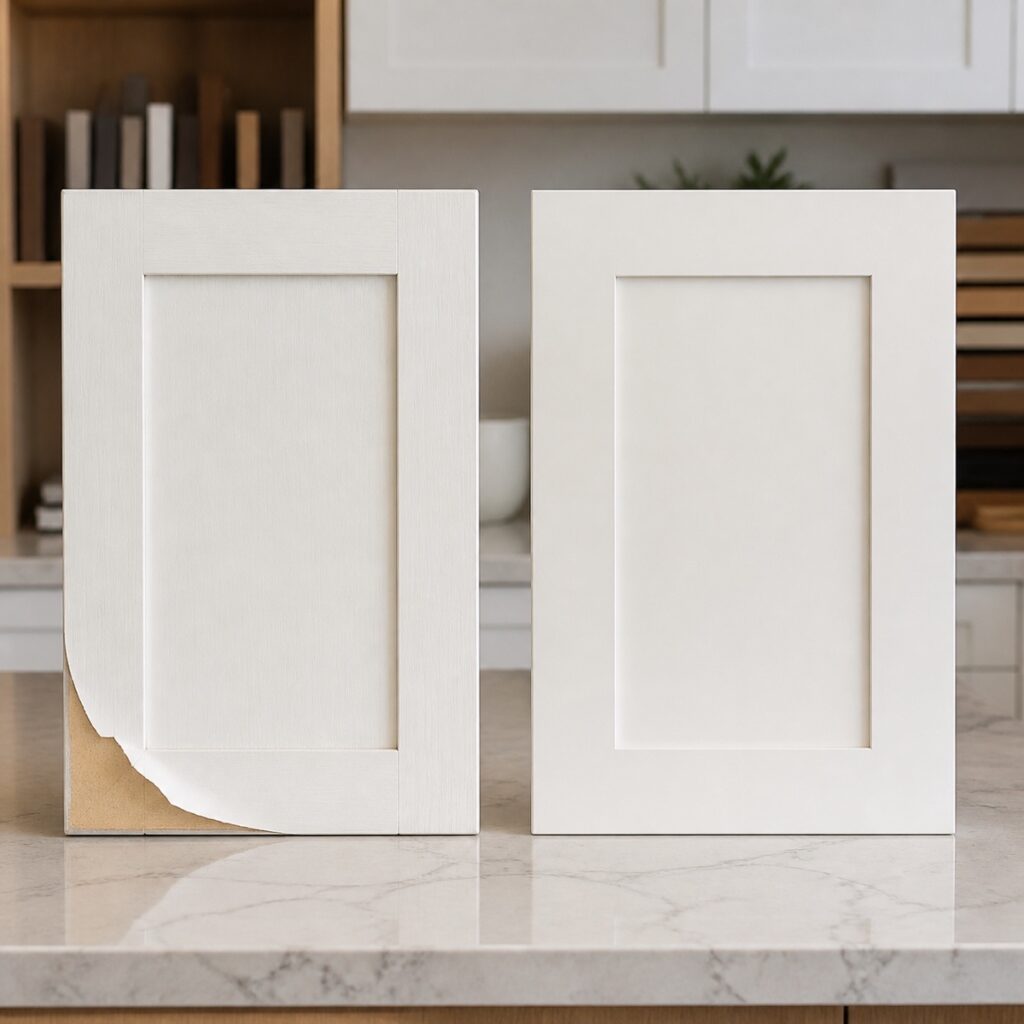
Peeling thermofoil cabinets can sometimes be painted, but only after the failing vinyl is removed and the material underneath is proven sound. Paint cannot stop thermofoil that is still releasing from a door. When lifting is widespread, the substrate is swollen, or the homeowner wants a different door style, refacing is usually the more dependable direction.
The important question is not “Will paint stick to this loose corner?” It is “What is actually failing, and is the rest of the kitchen a stable surface worth keeping?” That diagnosis prevents a small visible symptom from driving the wrong project.
Thermofoil peeling is a material problem, not just a paint problem
Thermofoil doors are typically made with a shaped substrate wrapped in a thin vinyl surface. The wrap creates a smooth, consistent appearance, but heat, moisture, age, and adhesive failure can cause it to lift. Common warning areas include edges near a sink, doors beside a range, and panels exposed to steam or repeated cleaning.
Once the vinyl has separated, coating the top does not reconnect it to the door. A new finish can only be as stable as the surface underneath it. If the wrap continues releasing after the project, the new coating can move or peel with it. That is why covering the visible edge without checking the rest of the door is not a complete repair.
The cabinet boxes may be a different material from the doors and may still be in good condition. A peeling door does not automatically mean the whole kitchen must be removed. It does mean the doors, boxes, and source of the damage should be evaluated separately.
First identify what is actually lifting
Not every white cabinet with a lifted edge is thermofoil. The failure could involve a vinyl wrap, a painted finish, a veneer, edge banding, or a swollen substrate. Those conditions may look similar in a photo, but they lead to different repair choices.
A useful assessment checks whether the surface feels like a flexible film, whether lifting appears at several edges, and whether heat or moisture is concentrated nearby. It also looks for bubbling, cracking, softness, swelling, dark staining, and distortion. The goal is to separate an adhesive failure from water damage or a poor previous coating.
ColorUp handles that condition review before writing the scope. Our team identifies the visible material, compares affected doors with unaffected ones, and checks the boxes and exposed panels. Homeowners should not be asked to strip doors, sand uncertain surfaces, or test coatings themselves.
When painting may still be a reasonable option
Painting may be worth considering when the wrapped surface can be removed cleanly, the substrate remains dry and structurally sound, the door profile is still desired, and the condition is consistent enough to prepare as one system. The evaluation must include more than the single edge that first caught your attention.
The surface beneath the wrap matters. Some substrates can be prepared for a professional coating system; others may be damaged, uneven, or unreliable after the vinyl is removed. The contractor should explain what will remain, how it will be prepared, and whether the finished doors will match the boxes and fixed trim.
Painting also makes more sense when the homeowner wants to keep the existing door style. If the real goal is to move from a dated raised panel to a clean Shaker profile, repairing the old wrap does not solve the design problem. Our cabinet painting service overview explains what a finish-focused project can and cannot change.
When refacing is the safer direction
Refacing becomes more compelling when the boxes and layout are useful but the doors are no longer dependable. New doors and drawer fronts remove the failing wrapped components from the equation. They can also change the visible style without removing sound cabinet boxes.
Widespread bubbling, repeated heat damage, swelling, mixed door conditions, or vinyl that releases with light handling are signs that a paint-only proposal deserves caution. A homeowner should not pay for a premium finish over a surface that is still moving underneath it.
Refacing is also a design choice, not only a repair. It can address worn door profiles, exposed end panels, uneven visible components, and a desire for a different overlay or style. Learn how cabinet refacing changes the visible parts of the kitchen while preserving the parts that still work.
Compare the whole kitchen before choosing the scope
A single peeling corner can be the first clue, but it should not be the entire basis for the decision. Look at how many doors are affected, whether failures cluster near heat or water, and whether the boxes remain square, dry, and functional. Then decide whether the current door style is something you actually want to keep.
The decision can be reduced to three questions. Is the substrate sound enough to finish? Is the failure isolated or likely to continue across the kitchen? Does the existing door style still support the look you want? Painting is a finish solution. Refacing is a surface-and-style solution. Full replacement is reserved for deeper layout or structural problems.
For Greater Houston homes, sink leaks, cooking heat, and long periods of humidity can all be relevant context, but they do not determine the answer by themselves. The condition of the materials in that specific kitchen should control the recommendation.
Frequently asked questions about peeling thermofoil cabinets
Can you glue peeling thermofoil back down?
A small lifted area may sometimes be reattached, but the repair does not explain why the adhesive failed or whether other edges will follow. It is best treated as a condition question, not a guaranteed permanent fix.
Can thermofoil be removed and the MDF painted?
Sometimes. The wrap must be removed without leaving an unstable surface, and the MDF must remain sound, dry, and suitable for the preparation and coating system. The result depends on the actual door, not only the material label.
Do peeling doors mean I need all-new cabinets?
No. If the cabinet boxes and layout remain useful, painting suitable components, replacing selected doors, or refacing may solve the visible problem without removing the entire kitchen.
Will new paint hide swollen cabinet material?
No. Paint can change color and sheen, but it does not reverse swelling or restore damaged structure. Moisture damage must be identified before a finish is selected.
How do I decide between painting and refacing?
Compare substrate condition, how widespread the failure is, and whether you want to keep the current door style. A condition-based proposal should explain those three points clearly.
If you have lifting vinyl, bubbling near heat, or cabinet doors that no longer feel dependable, request a cabinet condition estimate. We will compare painting, selective door replacement, and refacing before recommending a finish.