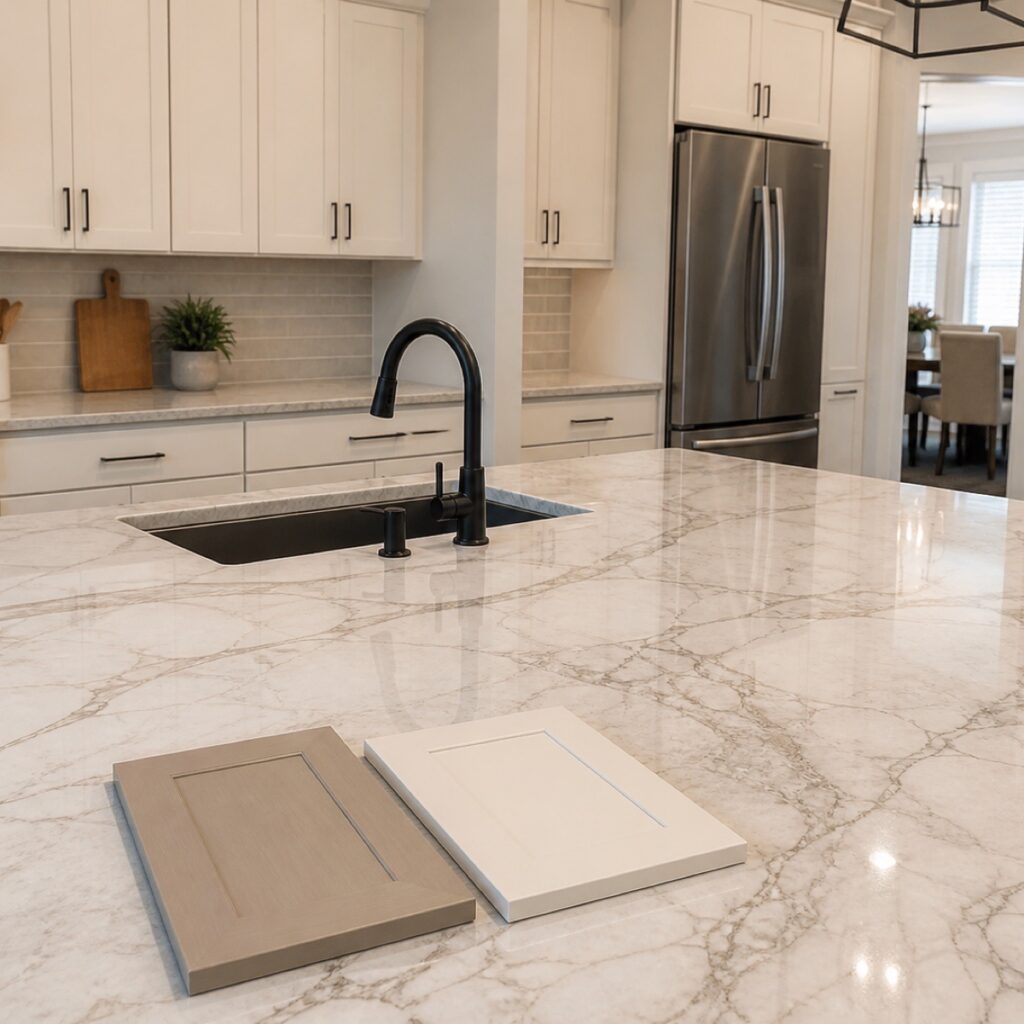
Fabrication Guide
By ColorUp Cabinets · Updated September 30, 2026 · Greater Houston
Most multi-piece kitchens need seams. Slabs have finite size; L, U, and island layouts rarely fit one piece. A good seam is tight, color-matched, and placed where the eye already expects a break — often findable up close, rarely the focal point from normal standing distance when planned. ColorUp documents a seam plan with layout and material. Seams are planned to be as discreet as the slab, layout, and material allow. We do not promise invisible seams.
ColorUp
CABINETS
Where should a seam sit?
Most multi-piece kitchens need one. Discreet is not invisible.
The plan is locked at template, before the saw. No public per-seam menu.
Kitchens need seams
Locked before fabrication
Discreet — not invisible
Why seams exist (slab size + layout)
A straight galley may need fewer breaks than an L or U with an island. Pattern matching and yield on busy stones can force extra seams even when a quieter slab might span farther. That is a fabrication and material reality, not a sales trick. Vertical full-height slab backsplashes are a different seam problem — see slab backsplashes: what the seam plan decides.
What “good” vs “bad” seams look like
Quality shows in placement, gap tightness, tinted adhesive match, and vein alignment intent — not in marketing words like “phantom” or “invisible.” Solid-color or quiet quartz often shows a line more than heavily veined stone, because there is less movement to camouflage the joint. Bad seams are mid-run on a blank field under hard sidelight, poorly matched fill, or surprises sprung on install day.
ColorUp’s service process: laser template, CNC cut, seams set according to the documented plan. Process copy on /services/countertops/ matches that honesty.
Prefer / avoid placement zones
- Prefer: inside corners; natural layout breaks; away from the visual center of a quiet field when the layout allows
- Discuss carefully: proximity to sink or cooktop cutouts — fabricators care about support and stress; this is plan conversation, not a DIY engineering recipe
- Avoid as defaults: mid-run on a blank white field when another break exists; treating “no seams” as a guarantee on multi-piece kitchens
No invisible-seam guarantee
If a quote promises zero visible seams on a typical L or island kitchen, ask how slab size and layout make that possible. ColorUp will not compete on that absolute.
When the seam plan is locked
At layout and template — not as a surprise when stone arrives. The laser template visit captures as-built geometry; seam discussion belongs in that file. Related guide: laser templating expectations. Price impact is qualitative: seam count and complexity are cost drivers on the written proposal after templating (/facts/) — ColorUp does not publish a $/seam menu.
Painted cabinets and open-concept light
Bright Houston sidelight can rake a seam that looked quiet under showroom light. New painted cabinets do not hide a poorly placed joint; slab choice and plan do. When cabinet finishing and stone are both in scope, the written schedule coordinates finish protection, templating, and installation.
How material choice changes seam visibility
Quiet quartz and solid colors put the joint on display. Busy quartzite, granite, and marble-look prints can hide a well-matched seam inside movement — that is camouflage, not invisibility. Bookmatching and pattern continuation are intentional fab choices with yield consequences; they can add slab use. When the island gets a waterfall, the vertical miter is another planned seam, covered in the waterfall guide rather than here.
Homeowner tape measures do not set seam count. A DIY square-foot sketch from how to measure countertops helps early budgeting talk; the laser template and documented plan set fabrication. If a salesperson sells “zero seams” without walking slab size against your L or U, ask for the layout drawing.
ColorUp’s investment language already treats seam plan as a price driver. That stays qualitative on the written proposal after templating — never a public $/seam add-on chart.
Frequently asked questions
Do L-shaped kitchens always need a seam?
Almost always, because two runs rarely fit one unbroken slab. Exact count depends on slab size, overhangs, and yield.
Do solid white quartz seams show more than veined stone?
Often yes. Quiet fields reveal lines; movement can camouflage them. Plan placement accordingly.
Should a seam run through the sink?
Sometimes fabricators place a seam at or near a sink for yield or support reasons. It is a documented plan decision, not a homeowner improvisation.
Who decides seam locations — and when?
ColorUp documents the plan with you before fabrication, based on layout, material, and template.
Are waterfall miters “seamless”?
No. A mitered waterfall is still a seam. See the waterfall island guide.
ColorUp laser-templates, documents seam placement, and fabricates to that plan — discreet as slab, layout, and material allow.See the seam plan before the saw runs