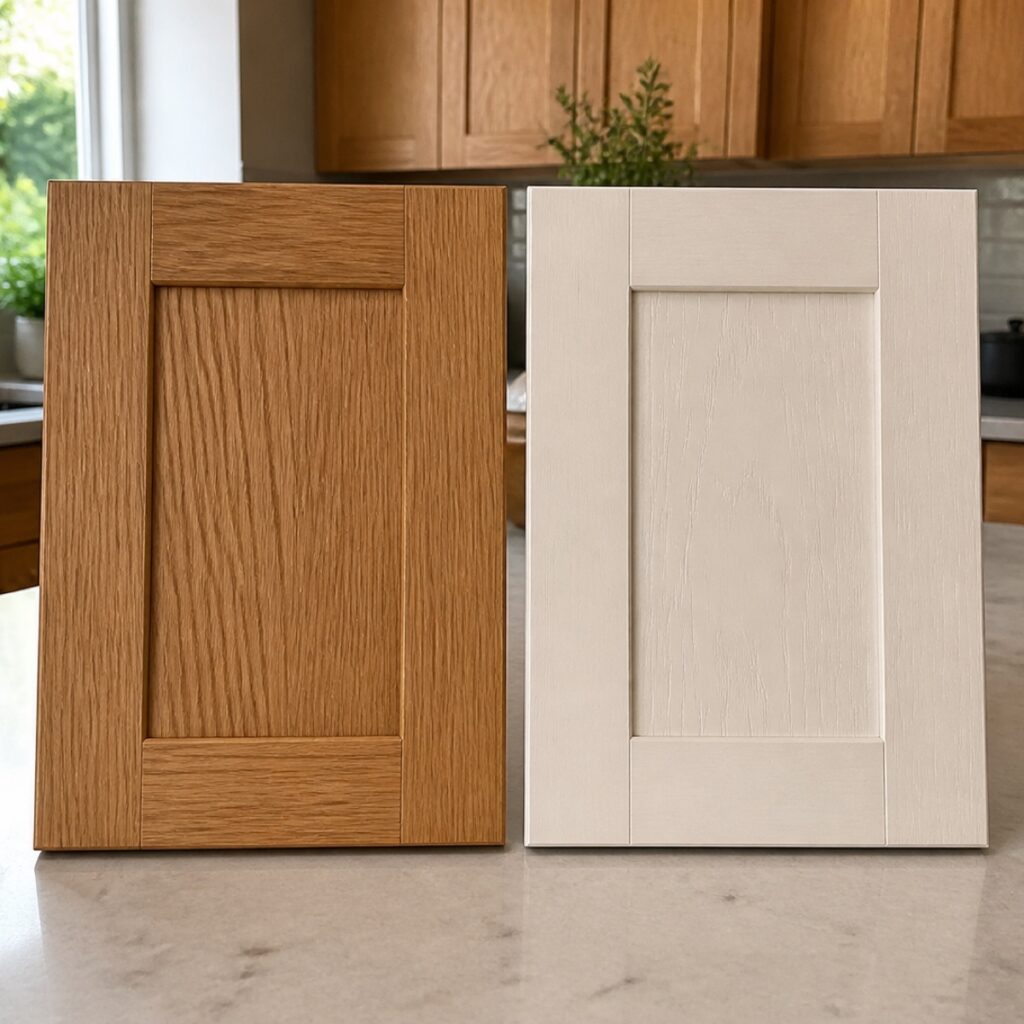
The Step Most DIYers Skip: Filling Oak Grain Before Painting
Oak cabinets have deep, open pores that show through paint like a road map. Here’s exactly how professionals fill them — and why skipping this step ruins an otherwise good paint job.
Why Oak Shows Through Paint — and Other Woods Don’t
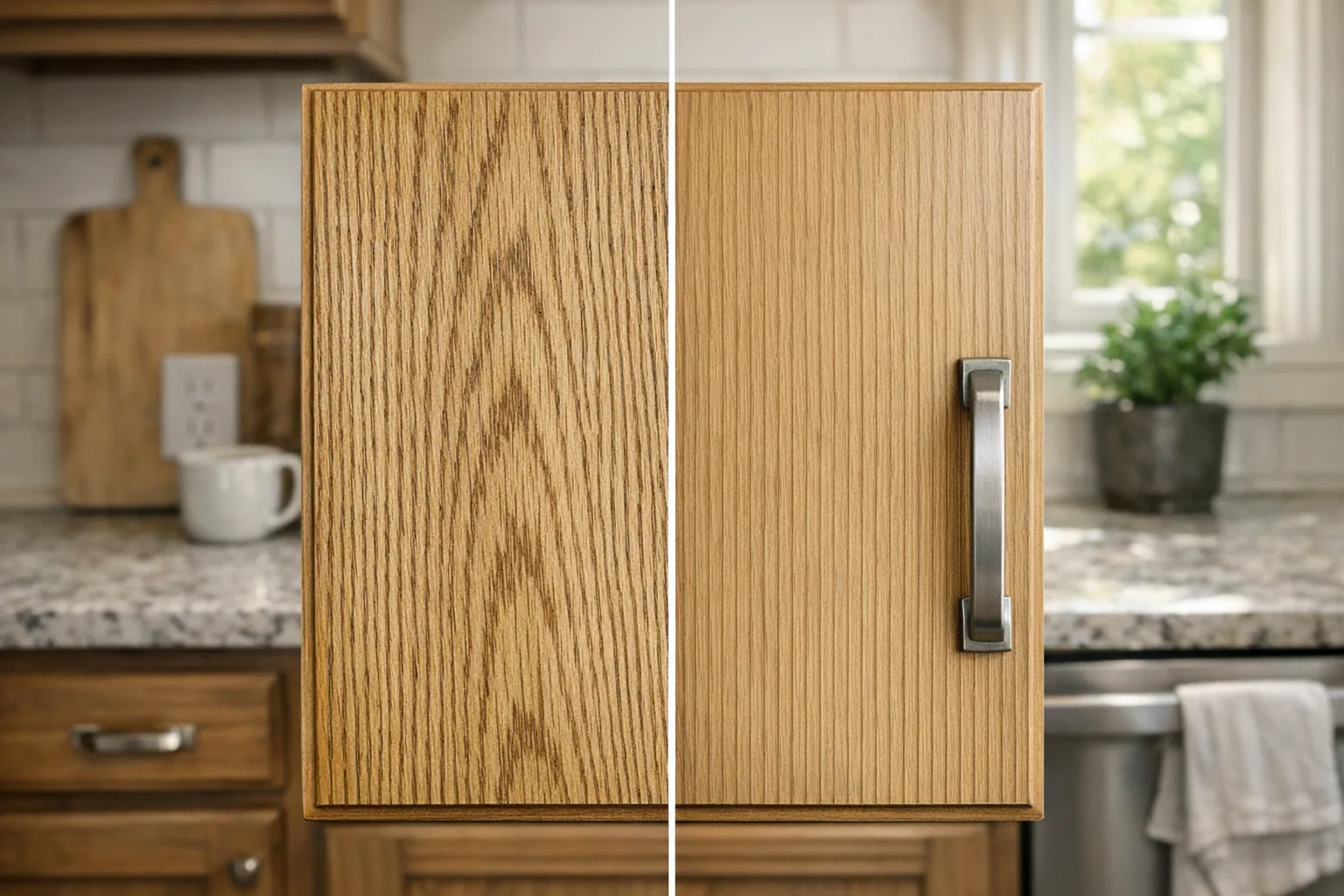
Not all wood is the same under the surface. Some species have tight, closed pores. Others have wide, open channels that run deep into the wood. Oak falls firmly in the second category.
Wood scientists call oak a “ring-porous” hardwood. That means its growth rings contain large vessel pores — basically tiny trenches — that run the length of each board. On a piece of flat-sawn red oak, those channels can be 0.3 to 0.5mm wide and just as deep.
That doesn’t sound like much. But paint doesn’t fill those channels. It bridges over them like a tarp over a pothole. The result is a bumpy, textured surface that catches light and looks rough — even after two or three coats of high-quality paint.
Maple, MDF, and poplar don’t have this problem. Their pores are so small that paint levels right over them. That’s why painted maple cabinets look like factory finishes and painted oak cabinets — without grain filling — look like someone painted over a wood texture wallpaper.
Hold a flashlight at a low angle across your cabinet door surface. If you can see a ripple or channel pattern in the reflection, that’s open grain. Paint alone will not fix that. Grain filler will.
The Two Products Pros Actually Use for Oak Cabinet Grain Filler
Walk into any professional cabinet finishing shop and you’ll see one of two products on the shelf. Both are purpose-built for this exact problem.
Aqua Coat Clear Grain Filler
This is the go-to for most oak cabinet projects. It’s water-based, dries in about 30 minutes, and sands back cleanly with 220-grit paper. It goes on clear, so there’s no guessing about color compatibility. It works with any water-based primer or topcoat.
Aqua Coat is ideal for oak with moderate grain patterns — think flat-panel doors or frame-and-panel doors where the grain isn’t too aggressive.
Timber Mate Wood Filler
Timber Mate is a paste-style filler that handles deeper pores and more dramatic grain better than Aqua Coat. It’s particularly useful on older oak cabinets from the 1980s and 1990s — the kind you see constantly in Kingwood, Friendswood, and Pearland homes built during that era. Those cabinets often have heavy cathedral grain patterns that need a denser fill.
Some DIY videos suggest using lightweight spackle as a grain filler. Don’t. It’s not flexible enough for wood movement, it doesn’t bond reliably to bare wood, and it can crack or flake under kitchen humidity — which is a real issue here in Houston. Use a product designed for wood.
The Step-by-Step Grain Filling Process Professionals Follow
This process takes about half a day for an average kitchen’s worth of doors and drawer fronts. It’s not complicated — but the technique matters.
Step 1: Clean and Sand First
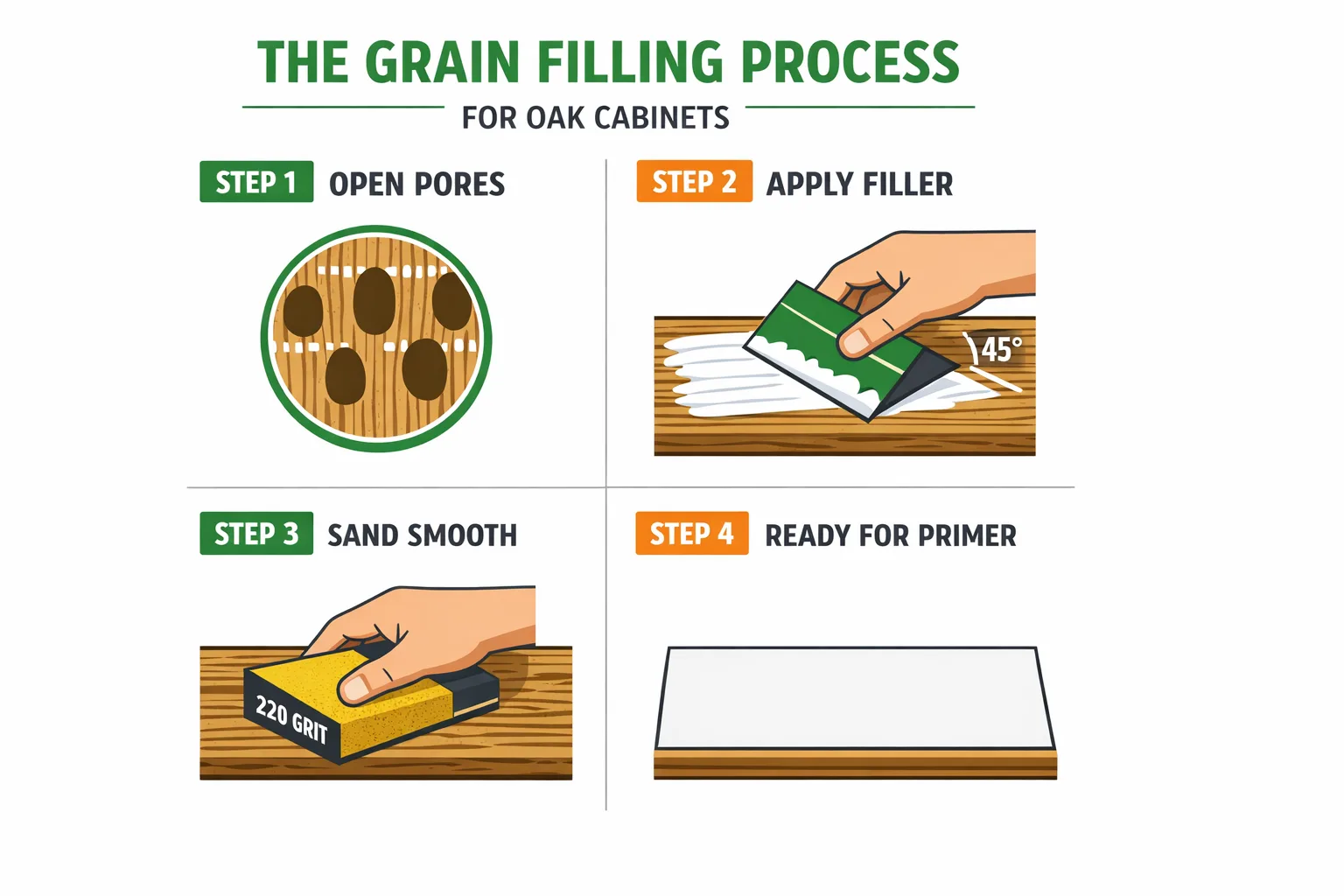
Grain filler goes on bare or lightly sanded wood — not on top of old finish. All existing finish, grease, and cleaner residue has to come off first. Sand with 120-grit to open the wood surface, then wipe clean with a tack cloth.
Step 2: Apply Filler at a 45-Degree Angle
This is the technique most DIYers miss. Use a stiff plastic spreader or credit card — not a brush. Apply the filler across the grain at a 45-degree angle. This forces the filler down into the pore channels instead of just skimming over them.
Work in sections. Don’t let the filler dry before you’ve spread it fully. On a standard 15″ x 24″ cabinet door, this takes about 60–90 seconds per face.
Step 3: Let It Dry, Then Sand Back
Wait for the filler to dry fully — about 30 minutes for Aqua Coat, up to an hour for Timber Mate in humid Houston weather. Then sand back with 220-grit paper. The goal is to remove all filler from the flat wood surface and leave it only inside the pores.
After sanding, you should see a smooth face with faint gray or white lines where the pores are now filled. That’s exactly what you want.
Step 4: Inspect Under Raking Light
Hold a work light at a low angle across the surface. If you can still see channel texture, apply a second coat. If the surface looks flat and consistent, move to primer.
Pro Tips for Better Results
- Work in a cool, shaded space — direct Houston sun can dry filler before you spread it properly
- Always apply across the grain at 45 degrees, not with the grain
- Use a sanding block (not just paper in your hand) to keep sanding pressure even
- Wipe the surface with a damp cloth after sanding to raise any remaining grain before priming
- Don’t rush the dry time — humidity slows everything down in summer months
When You Need Two Rounds of Grain Filler
Flat-grain oak usually gets by with one coat of filler plus high-build primer. But cathedral grain patterns are a different story.
Cathedral grain is the arching, flame-shaped pattern you see on older raised-panel oak doors. The grain lines on those doors are tightly spaced and very pronounced. A single coat of filler can’t fully bridge all of them in one pass.
Flat / Straight Grain Oak
- Parallel grain lines
- Consistent pore depth
- Common on newer cabinet doors
- One coat + high-build primer is enough
- ~2 hours labor for average kitchen
Cathedral / Arched Grain Oak
- Arching flame-shaped pattern
- Variable pore depth across the door
- Very common on 1980s–90s Houston homes
- Two coats needed before primer
- ~4 hours labor for average kitchen
After the second coat is sanded back, the surface should feel glassy under your fingertips. If you still feel texture, one more pass is better than fighting it at the paint stage.
How High-Build Primer Adds a Second Smoothing Layer
Grain filler is step one. High-build primer is step two. These work as a system — and both matter.
Standard primer is thin. It se
Want a Perfectly Smooth Finish on Your Oak Cabinets?
Grain filling is a craft skill. Our team does this every week on kitchens across Houston. Get a free quote and see what a factory-smooth finish actually looks like.
Get My Free Estimate Text Us NowFrequently Asked Questions
Do you have to fill oak grain before painting?
You don’t have to — but you’ll almost certainly regret skipping it. Oak is an open-pore wood, which means its grain channels are deep enough to telegraph through multiple coats of paint. Even two or three coats of high-quality paint won’t fully hide the texture. Grain filler is what closes those channels and gives you a smooth, professional-looking surface.
What is the best grain filler for oak cabinets?
Two products pros reach for most often are Aqua Coat Clear Grain Filler and Timber Mate Wood Filler. Aqua Coat is water-based, sands easily, and dries fast — ideal for cabinet doors. Timber Mate is a paste-style filler that works well for deeper grain channels like you find on heavy cathedral oak patterns. Both are paintable, sandable, and compatible with water-based topcoats.
How many coats of grain filler do oak cabinets need?
Most flat-grain oak surfaces need one coat of grain filler, followed by high-build primer. But oak cabinet doors with a strong cathedral grain pattern — the wavy, arching lines you see on older raised-panel doors — often need two rounds of filler. The first coat fills the deepest channels; the second coat catches what the first round missed after sanding back.
Why do my painted oak cabinets still look grainy?
This almost always means grain filler was skipped, or the primer used wasn’t a high-build formula. Standard primers are thin and don’t have enough solids to bridge open pores. If you painted over bare or lightly sanded oak, the grain channels are still there under the paint — they just have a colored coating over them now, which actually makes the texture more visible under raking light.
Does grain filler work on hickory cabinets too?
Yes. Hickory is also an open-pore wood with dramatic grain patterns, and it benefits from the same grain-filling process as oak. In some cases hickory needs more filler passes than oak because its pores can be even more pronounced. The same products — Aqua Coat or Timber Mate — work well on hickory, ash, and other ring-porous hardwoods.
Can you paint oak cabinets without filling the grain?
Technically yes, but the finish will show grain texture — especially under kitchen lighting that hits the surface at an angle. Some homeowners are fine with a slightly textured look and prefer to skip the extra step. But if you want a clean, smooth finish that looks like a painted MDF or maple cabinet, grain filling is not optional. It’s the single biggest factor separating a professional oak paint job from a DIY one.