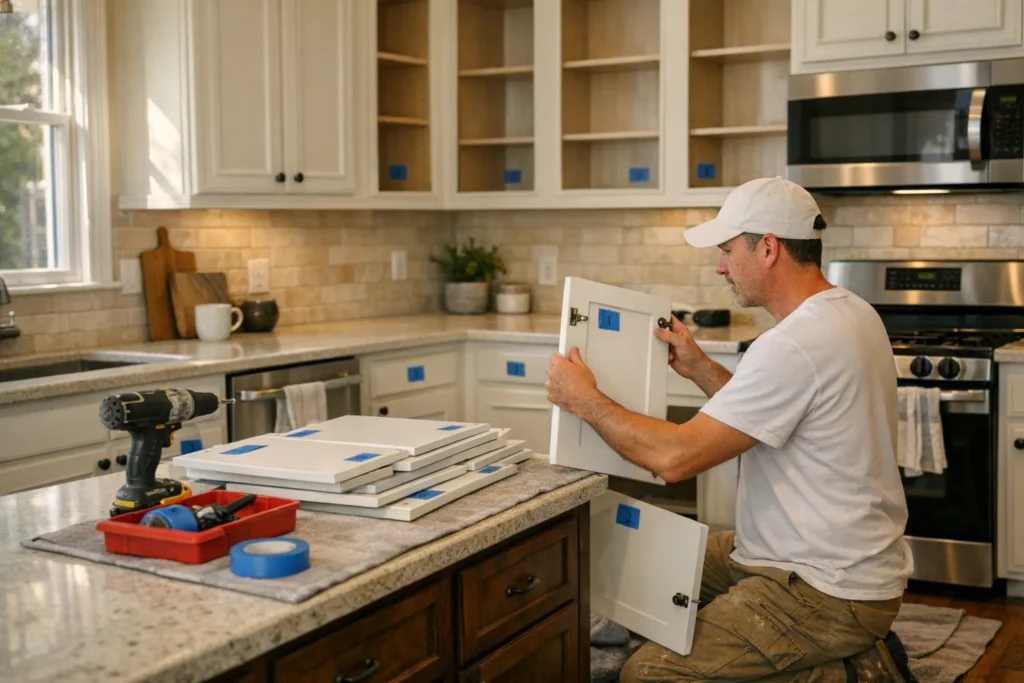
Process & Finish Location
By ColorUp Cabinets · Published September 30, 2026
Many high-quality cabinet painters remove doors and drawer fronts for controlled shop spray and finish fixed boxes on-site — “everything painted in the house” (or a garage) is a different process envelope. ColorUp shop-finishes doors with Renner 2K (three coats) and handles boxes in-home as scoped.
ColorUp
CABINETS
Where are the doors finished?
Shop and on-site are different envelopes. Neither is automatically best.
Boxes, protection, hardware, and reinstall still happen in the kitchen. Shop spray is not odor-free.
Neither approach is automatically “best.” The useful question is which process envelope the contractor controls — and whether that claim is written into the proposal.
Shop-sprayed doors
- Doors and drawer fronts finished off-site
- Controlled dust, temperature, and spray
- Fixed boxes still prepared and coated in-home
- ColorUp: Renner 2K, three coats on doors
Everything on-site
- Doors and boxes coated inside the home or garage
- Protection and airflow become the process limits
- Useful for some scopes; not the same envelope as shop spray
- Ask how dust, curing, and reinstall are handled
What “shop-sprayed” usually means
Shop finishing usually means doors and drawer fronts are labeled, removed, prepared, sprayed in a controlled environment, allowed to cure under managed conditions, then reinstalled and adjusted. Fixed cabinet boxes and face frames stay in the home and are finished there as scoped.
ColorUp uses that model for most kitchen painting. Removable doors and drawer fronts receive Renner Italia 2K polyurethane — three coats, AAA airless — in the Porter shop. The Kingwood brand home (77345) anchors the business; Greater Houston addresses are reviewed before scheduling. Shop logistics and street address are not published here.
Shop control helps with dust, overspray, temperature consistency, and film leveling. It does not remove all in-home work. Boxes, protection, hardware decisions, and reinstall still happen in your kitchen.
What “paint everything on-site” usually means
All-on-site work means doors are sprayed or brushed in place, or moved only to a temporary setup — a garage, driveway tent, or spare room — while the project stays entirely at the house. Done carefully, it can still produce a solid finish. Done under dust, traffic, unstable temperature, or poor masking, the film quality suffers.
Overspray risk, airborne dust settling into wet finish, and household traffic are the usual pressure points. Brush-and-roll on-site is another envelope entirely: it can look good with skill, but the film and texture differ from controlled shop spray.
Honest trade-off
Shop finishing improves control for doors. It also means doors leave the kitchen for part of the schedule. All-on-site keeps parts closer to home and can increase environmental risk on the finish.
What still happens in your kitchen either way
Regardless of where doors are sprayed, the crew still protects floors and adjacent surfaces, works on fixed boxes and frames, manages hardware plans, and helps you live through limited kitchen use. Daily-life tips belong on living through a cabinet project. Odor expectations — with hedges, not absolute promises — are covered in cabinet painting smell in the house.
Shop spraying doors reduces the amount of door-spray load inside living space. It does not make the project odor-free. Box work, primers, and reinstall still happen at home.
For the full project narrative, see what happens during a cabinet painting project and our process.
Shop doors + on-site boxes vs full on-site
| Factor | Shop doors + on-site boxes (ColorUp model) | Full on-site spray | Brush / roll on-site |
|---|---|---|---|
| Finish control | Higher for doors in controlled shop; boxes finished in-home as scoped | Depends on masking, dust, weather, and crew discipline | Skill-dependent; different film texture than spray |
| Dust / overspray risk | Door spray largely off-site; box work still needs protection | Higher in living space and temporary setups | Lower overspray; brush marks possible |
| Fumes in living space | Reduced door-spray load; not odor-free | More coating activity in or near the house | Varies by product; still present |
| Schedule logistics | Doors leave and return; reinstall/adjust built into plan | Parts stay closer; environment may slow quality work | Often simpler logistics; longer wet-edge management |
| Quality consistency | Shop QA on doors; boxes matched on-site | More variable room to room | Consistency depends on applicator skill |
| Homeowner disruption | Temporary door-off period; kitchen limits during box work | Continuous in-home coating activity | In-home work with different mess profile |
Homeowners often hear on forums: “Ask if the doors go to a booth.” That question is useful. The follow-up is better: what booth, what product, how many coats, and how reinstall is handled. A shop path only helps when the written scope matches the marketing language.
ColorUp’s Porter shop exists for door and drawer-front finishing quality — not as a showroom address to publish. The Kingwood brand home anchors the business identity. Greater Houston projects are reviewed for travel fit before a visit is offered.
Is a garage spray booth “shop finishing”?
A temporary garage booth can be better than spraying over carpet. It is not automatically equal to a dedicated shop process with established preparation, spray, cure, and quality checks. Ask what “booth” means in practice: filtration, dust control, temperature, how doors are racked, and who inspects film before reinstall.
If a quote says “factory finish” but means a weekend garage setup, ask for the written location of door finishing. Labels should match logistics.
How to verify a contractor’s claim on a quote
Get the location of finish work in writing
- Where doors and drawer fronts are finished — shop, garage, or in place.
- Coat count and product system — for ColorUp: Renner 2K, three coats (see also 2K vs retail cabinet paint).
- Reinstall and hinge adjustment included or excluded.
- Warranty years and exclusions on the signed proposal.
- Timeline for doors off the cabinets and kitchen usability during box work.
Pair this page with compare cabinet quotes for scope anatomy and hire checklist questions for the interview list.
ColorUp’s path for Greater Houston
ColorUp shop-finishes doors with Renner 2K (three coats) and handles boxes on-site as scoped. Typical cabinet painting runs 3–5 days; the written schedule controls after preparation, finish, and in-home sequence review (/facts/).
Planning ranges for painting: most full kitchens $3,500–$9,500; kitchen painting usually from $3,500; $2,500 for smaller standalone scopes only. Quoting uses a linear-foot method tied to scope and condition — not published per-foot or per-door menus. Service details: cabinet painting.
Frequently asked questions
Do they take the doors away?
In a shop-finished model, yes — doors and drawer fronts are labeled, removed, finished off-site, then reinstalled. Ask how long they are gone and how boxes are protected meanwhile.
Are the boxes painted in the house?
Usually yes. Fixed boxes and face frames stay in place and are finished on-site as scoped, whether or not doors go to a shop.
Which approach has fewer fumes and less dust?
Shop-finishing doors typically reduces door-spray load in living space. Box work, primers, and reinstall still create some odor and require protection. No honest process is completely dust- or odor-free.
How long are doors off the cabinets?
It depends on the written schedule. ColorUp’s typical painting window is 3–5 days overall; door-off timing is confirmed after the sequence is reviewed. Use the proposal, not a verbal guess.
Is garage spray the same as a controlled shop?
Not automatically. A garage setup can be better than spraying over finished floors, but dedicated shop process and QA are a different standard. Ask for specifics in writing.
See how shop-finished doors fit your kitchen
ColorUp can walk through door removal, shop finish, on-site box work, and a written 3–5 day painting schedule for Greater Houston homes.
Request a Cabinet EstimateFor Houston planning ranges and the linear-foot / written-scope method (no public unit menus), see the cabinet painting cost guide.