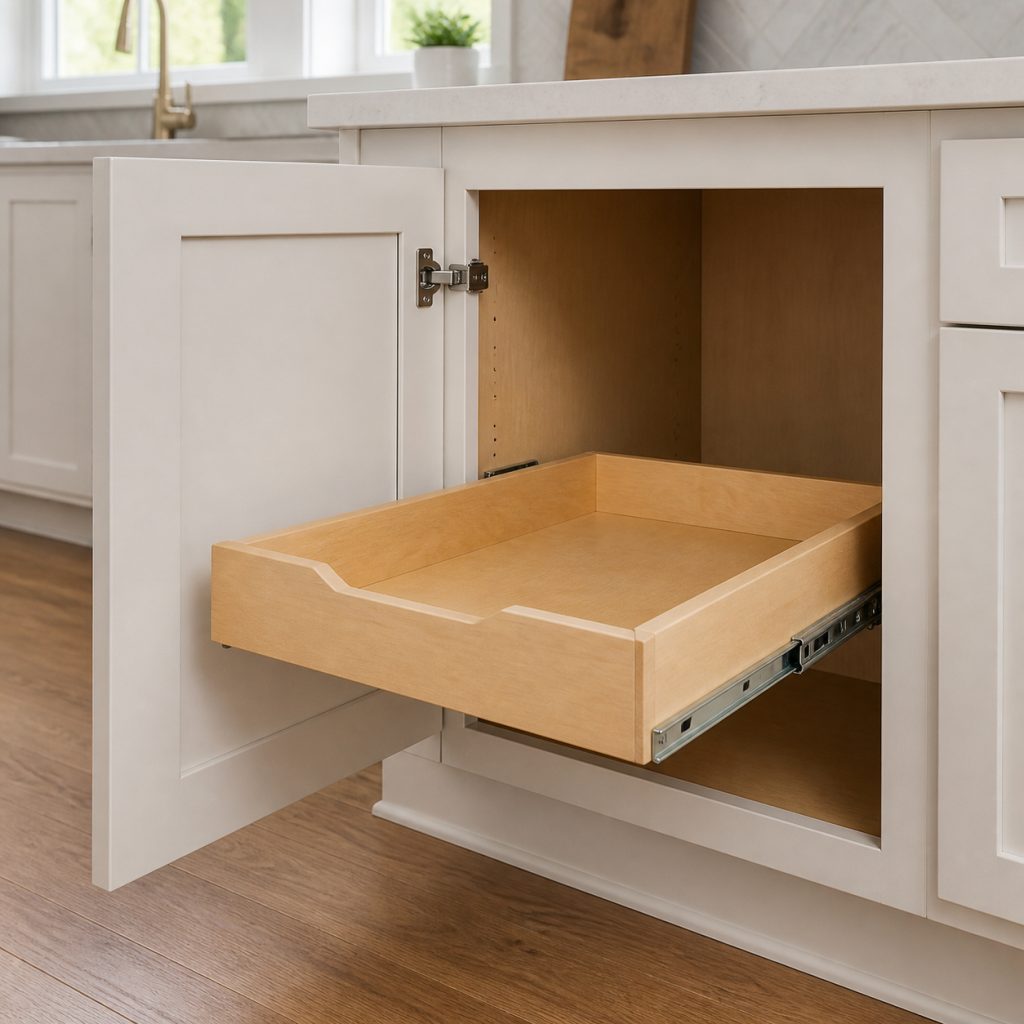
A kitchen can look freshly updated and still feel old every time a door slams, a drawer sticks, or a deep base cabinet makes you kneel to find one pan. Soft-close hardware can improve those daily moments—but only when the right part is matched to the right cabinet.
Soft-close is a controlled finish—not a single product
“Soft-close cabinets” sounds like one item, but it describes a result: the door or drawer slows during the final part of its travel and closes without a hard impact. The mechanism may be built into a concealed hinge, integrated into a drawer slide, or added as a compatible damper. Those parts are not interchangeable. A hinge controls a door. A drawer slide controls a drawer box. A rollout tray inside a cabinet is another moving component with its own slides and clearance needs.
That distinction matters because homeowners often point to one noisy cabinet and ask for soft-close everywhere. The better first step is to identify what is actually moving. Is it a hinged door? A standard drawer? A pull-out trash unit? A maple rollout tray? Each system has different mounting points, dimensions, weight demands, and compatibility limits. An upgrade should solve the motion you notice without creating a new alignment or clearance problem.
The useful question
Do not begin with “Can you add soft-close?” Begin with “Which doors, drawers, or pull-outs bother us in daily use, and what hardware controls each one?”
Three systems homeowners often group together
Door hinge
Controls the swing and final close of a cabinet door.
Drawer slide
Supports the drawer box and controls extension and closing.
Rollout system
Moves a tray or accessory inside an open cabinet.
A soft-close hinge usually contains a small hydraulic or friction-based mechanism that slows the door near the cabinet face. Some hinge families allow the damping strength to be adjusted or disabled on an individual hinge. That can matter on a very light or narrow door, where too much resistance may make the door feel reluctant to close. The hinge must also fit the door overlay, cabinet construction, cup boring, opening angle, and mounting plate position.
A soft-close drawer slide does more work. It supports the drawer, guides its travel, and pulls it through the last portion of closing. Side-mount and undermount systems have different space requirements. Undermount slides can create a cleaner visual because much of the mechanism sits beneath the drawer, but the drawer box must be built for that hardware. A side-mount replacement may be more practical when an existing drawer box and cabinet opening already match that style.
A rollout tray is a drawer-like accessory behind a cabinet door. It should not be confused with the cabinet’s exterior drawer stack. The door must open far enough for the tray to pass without rubbing the hinge, door edge, face frame, or neighboring hardware. The tray slides must also be mounted square and at a height that clears the threshold. This is where a visually convincing idea can fail mechanically: if the hinge occupies the rollout path, the tray cannot travel as shown.

Can existing cabinets be upgraded to soft-close?
Often, yes—but “existing cabinets” covers many construction types and decades of hardware. A practical evaluation starts with the cabinet boxes, doors, drawer boxes, and openings. The goal is not to force the same hinge or slide into every kitchen. It is to find a compatible system that closes correctly, stays aligned, and does not weaken the existing parts.
What should be checked before hardware is ordered
- Cabinet construction: face-frame and frameless cabinets use different hinge and mounting-plate relationships.
- Door overlay and inset: the amount a door covers the opening affects hinge selection and adjustment.
- Existing hinge boring: concealed hinges often use a cup in the door, but size and location still need confirmation.
- Drawer-box dimensions: width, bottom construction, rear clearance, and side spacing determine which slides can fit.
- Door and drawer condition: loose joints, split material, or badly worn screw holes may need repair before new hardware can hold adjustment.
- Accessory clearances: rollout trays, trash pull-outs, spice racks, plumbing, and appliance panels all need room to travel.
Doors that already use common concealed hinges may have a straightforward path to a compatible soft-close hinge. Older exposed hinges, unusual overlays, partial-inset doors, or damaged boring can require more planning. Drawers deserve the same honesty. Replacing a basic side-mount slide with another side-mount system can be less invasive than changing to undermount hardware, because undermount slides may require a different drawer width, notches, locking devices, and bottom clearance.
This is why a hardware discussion belongs inside the larger cabinet scope. If doors are being removed for cabinet painting or refinishing, hinge decisions can be made before the finish process and reinstallation. If the homeowner wants a different door style, cabinet refacing may make hinge compatibility easier to plan because the new doors can be prepared for the selected system. The hardware should follow the actual cabinet construction—not a generic online parts list.
A quiet close is not enough if the cabinet cannot move freely
Good hardware is almost invisible in use. The door swings without scraping. The rollout clears the hinge. The drawer opens fully without striking a neighboring pull. The final inches of travel feel controlled, but the mechanism does not fight the user. Reaching that result takes more than attaching a damper.
A functional upgrade
- Hinge and rollout occupy separate clearance zones
- Slides are level, square, and sized for the drawer
- Doors open far enough for interior accessories
- Adjustment remains accessible after installation
- Hardware is selected for the cabinet construction
A parts-only approach
- One hinge is assumed to fit every door
- Drawer spacing is guessed from the old hardware
- Rollouts are added without checking door swing
- Misalignment is treated as a minor cosmetic issue
- The mechanism is chosen before the cabinet is measured
Face frames can reduce the clear width available to a rollout. A thick door or a hinge with a limited opening angle can narrow the path further. Pull-outs near a range, dishwasher, or perpendicular cabinet run may have neighboring doors and appliance handles to consider. Even exterior hardware matters: a long pull can strike the pull on the next cabinet when two doors meet at a corner.
Adjustment is part of installation, not evidence that the parts are failing. Concealed hinges are designed to move the door slightly up, down, in, out, left, or right so reveals become consistent. Drawer slides also depend on parallel mounting. A soft-close mechanism can magnify poor alignment because it adds controlled resistance near the end of travel. If a door is sagging or a drawer box is racked, the hardware may feel inconsistent until the underlying geometry is corrected.
When soft-close upgrades are worth considering
Soft-close is most valuable when it fixes a repeated frustration. A kitchen with many daily users may benefit from quieter doors and drawers. Heavy pot drawers can feel more controlled. Rollouts can bring stored items forward instead of making the homeowner reach into a deep base cabinet. A pull-out trash unit can close with less impact on the cabinet face. None of these changes makes the kitchen larger, but they can make the existing space feel more deliberate.
The upgrade can also protect adjustment and reduce repeated impact, but it should not be sold as a cure for damaged cabinets. A soft-close hinge cannot repair a split door stile. New slides cannot straighten a badly racked drawer box. A rollout tray cannot solve plumbing that occupies the same space. Those conditions should be addressed first or included honestly in the scope.
Not every door needs identical damping. Very small doors can feel over-damped, while large or heavy doors may need the correct number and type of hinges. Some homeowners care most about the main drawer stack, trash pull-out, and frequently used doors. A selective upgrade can be sensible when compatibility is mixed or the household’s pain points are concentrated in a few locations.
Identify the moving part, verify cabinet compatibility, then choose the hardware.
Make the hardware decision before the finish work begins
Hardware changes are easiest to coordinate before cabinet doors return with a new finish. If hinge holes need repair, doors need new boring, old pull holes will be filled, or drawer boxes require modification, those details should be known before the finish schedule is locked. Waiting can create avoidable touch-ups or limit the hardware choices to whatever fits the existing holes.
Start by listing which doors and drawers are staying. Decide whether visible pulls will be reused, resized, or moved. Confirm whether the scope includes hinges, standard drawers, pull-outs, or interior rollout trays. Then verify lead times and compatibility before removing usable hardware. A written proposal should say what is included rather than using “new hardware” as a catch-all phrase.
The same sequence helps when cabinet color, countertops, and visible hardware are changing together. Brass, black, nickel, and bronze pulls influence the design, but the hidden hinges and slides influence the experience. Both deserve a decision. ColorUp’s role is to keep the cabinet finish, doors, and agreed hardware scope coordinated; plumbing, electrical, and specialty trade responsibilities should remain clearly assigned when the larger kitchen plan includes them.
Questions to ask before approving a soft-close scope
A clear conversation should connect each proposed part to a specific cabinet. Ask which hinge or slide family is being considered and why it fits. Ask whether existing doors and drawer boxes can be reused without weakening them. Ask what happens where face frames, corner doors, pull-outs, or appliance handles reduce clearance. Ask whether adjustments and care will be explained at handoff.
For rollout trays, ask to see the door open and the tray extended before considering the work complete. The tray should move without touching the door, hinge, or face frame. For drawers, test them empty and with normal household weight after installation. For doors, check consistent reveals and make sure adjacent doors can open together where expected.
Finally, ask what is not included. If damaged drawer boxes, specialty organizers, replacement doors, or new visible pulls are outside the price, the proposal should say so. Clarity protects both the homeowner and the project team. It also makes competing quotes easier to compare because the same words are tied to the same work.
Soft-close cabinet FAQs
Can soft-close hinges be added to old cabinet doors?
Many existing doors can accept compatible concealed soft-close hinges, but the answer depends on cabinet construction, overlay, hinge boring, door condition, and opening clearance. Older exposed or unusual hinges may require a different plan.
Can you convert existing drawers to soft-close?
Sometimes. The drawer box width, bottom, rear clearance, side spacing, and cabinet opening determine which slides can fit. A change from side-mount to undermount slides may require drawer-box modification or replacement.
Are soft-close hinges the same as self-closing hinges?
No. Self-closing means the hinge pulls the door closed from part of its travel. Soft-close adds damping so the final movement is controlled. A hinge may offer both functions, but the terms describe different behavior.
Will soft-close hardware fix a crooked door?
Not by itself. Concealed hinges allow adjustment, but loose mounting, damaged screw holes, a warped door, or an out-of-square cabinet must be addressed for the alignment to hold.
Do rollout trays need special hinges?
They need enough door-opening and hinge clearance to travel through the opening. The exact hinge depends on the cabinet and door. The tray, slide, face frame, and door swing must be evaluated together.
Should soft-close be planned during cabinet painting?
Yes, if hardware will change. Planning before refinishing allows hole repairs, boring, compatibility checks, and reinstallation details to be included before the finished doors return.
Plan the cabinet experience—not just the color
ColorUp Cabinets can evaluate your existing doors, drawers, rollout clearances, and finish goals, then explain which upgrades fit the kitchen you already have.
Request a cabinet project estimateColorUp Cabinets serves homeowners across the Houston metro, including Bellaire, West University, Memorial, Tanglewood, River Oaks, The Woodlands, Kingwood, Katy, and surrounding communities. Call (346) 201-5663 or use the estimate form to begin with photos of your current cabinets.