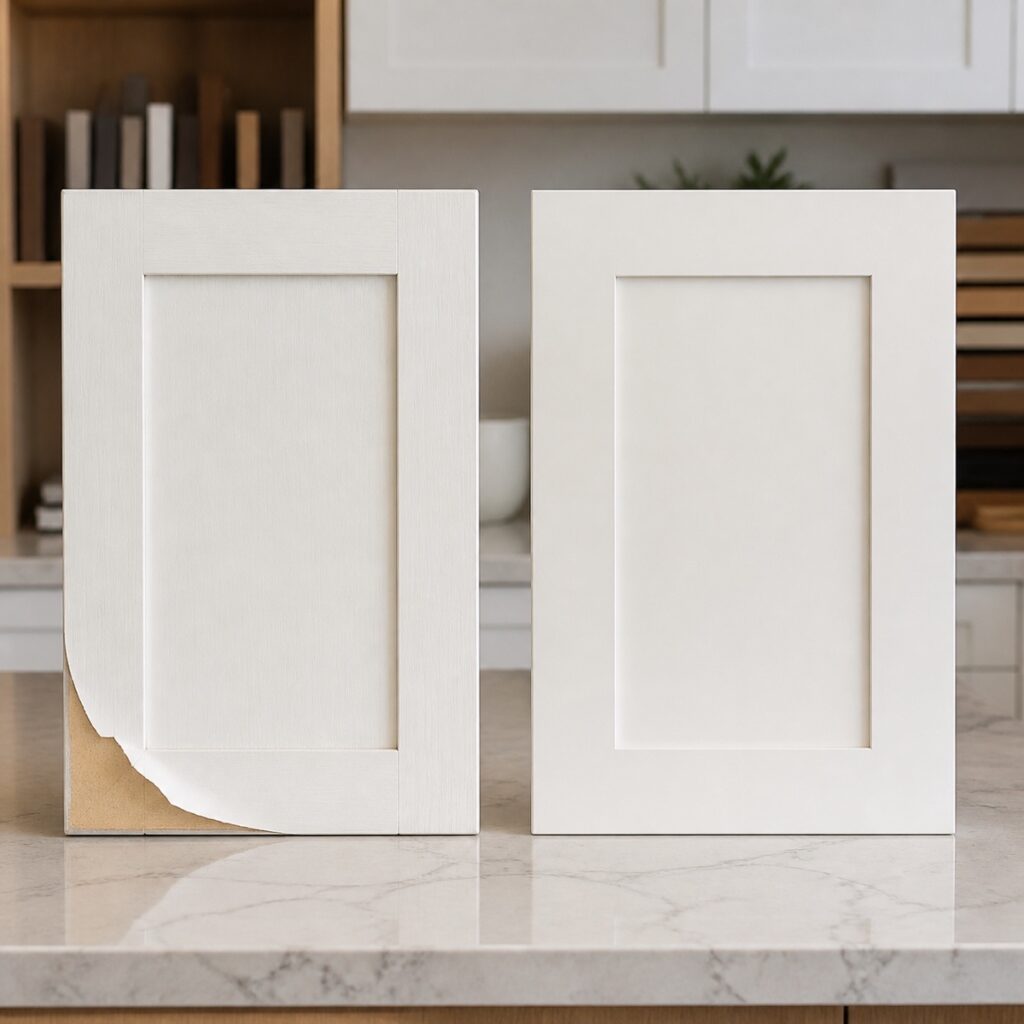
Thermofoil · Three-Way Decision
By ColorUp Cabinets · Published September 30, 2026
Paint belongs on thermofoil or vinyl doors only after failing wrap is addressed and the substrate is proven sound — paint cannot glue actively peeling wrap in place. Reface when boxes and layout still work but doors are unreliable or the style must change. Replace — referred out by ColorUp — when boxes or layout fail.
For the deep paintability diagnosis (when wrap can come off and MDF can take a coating), start with the sibling article peeling thermofoil cabinets painted.
Diagnose doors and boxes separately
Peeling wrap on doors does not automatically mean the whole kitchen must go. Boxes can be square and dry while door skins lift at edges near the dishwasher, sink, or range. The useful habit is to separate door condition from box condition before anyone prices full replacement.
Check how many doors are affected, whether failures cluster at heat and steam, whether substrate feels soft or swollen under the wrap, and whether boxes are still dry and square. Widespread bubbling with soft cores is a different problem than one isolated edge lift on an otherwise firm door.
Not everything white-and-peeling is thermofoil
Homeowners often say “thermofoil” for any plastic-looking peel. Some failures are paint adhesion, veneer, or edge banding — not a heat-pressed vinyl wrap. Mislabeling the material can push the wrong repair. A site review should identify the skin and the substrate before paint or reface is promised. Painted finish failure modes (different from wrap adhesive failure) are covered on why painted kitchen cabinets chip or peel. Water-swollen material belongs with water-damaged kitchen cabinets after a sink leak.
Paint does not stabilize active peel
Coating over lifting vinyl traps a failing adhesive layer. Honest paint scopes address wrap removal and substrate soundness first — or they recommend refacing instead.
Path A — Paint (when it can still make sense)
Painting can still make sense when the wrap can be removed cleanly, the underlying door material is dry and sound, you still want the current door profile, and condition is consistent enough for one finish system. That diagnosis is the focus of peeling thermofoil cabinets painted — use that page for paintability detail; use this page to compare paint against the other two paths.
ColorUp’s painting path uses Renner Italia 2K polyurethane — three coats, AAA airless — with doors typically shop-finished and boxes finished on-site as scoped. This is not a DIY strip-and-spray recipe. Planning ranges: most full kitchens $3,500–$9,500; kitchen painting usually from $3,500; $2,500 for smaller standalone painting only. Service: cabinet painting.
Path B — Reface (often the dependable middle)
Refacing replaces doors and drawer fronts over sound boxes. It fits when wrap is widespread or unreliable, substrate under the wrap is questionable, or you want a different profile (painting cannot invent Shaker from a raised or wrapped profile — see painting cannot change door style). New doors solve both failing skins and style in one scope when the boxes earn keeping.
Houston planning range for refacing: $5,000–$12,000 per /facts/. Written proposal after door, panel, hardware, and fabrication scope controls. Service: cabinet refacing. General comparison: cabinet painting vs refacing.
Refacing also pairs cleanly with a color change. New doors arrive ready for the finish system you approve — without asking a failing wrap to carry another coating. If you like the current profile and only the wrap is failing, paint may still compete; if you dislike both the wrap and the profile, reface usually collapses two problems into one scope.
Path C — Replace / refer out
Full replacement belongs when boxes are damaged beyond practical keep, moisture has failed the structure, or layout, plumbing, or electrical must change. Refacing needs sound boxes; painting needs sound substrates. Neither rebuilds a failed carcass or rearranges the kitchen.
ColorUp does not install full cabinet replacement. When that is the honest answer, we refer you to a custom builder — stated on /facts/. Broader keep-vs-replace framing: paint or replace cabinets.
Decision scorecard
| Condition / goal | Lean paint | Lean reface | Lean replace / refer | Why |
|---|---|---|---|---|
| Isolated edge lift; substrate firm; keep style | Yes, if wrap addressed and substrate proven | Optional if you want new doors anyway | No | Limited failure can still support a paint system |
| Widespread bubbling / lift | Only with clear wrap-removal + sound cores | Often safer | If boxes also failed | Unreliable skins favor new doors |
| Swollen / soft doors | No | If boxes still sound | If boxes share the damage | Soft substrate is not a paint base |
| Hate current profile (want Shaker, etc.) | No for style change | Yes when boxes work | Only if layout/boxes fail | Paint cannot change door geometry |
| Boxes water-failed | No | No | Yes | Reface and paint need keepable boxes |
| Layout / plumbing change needed | No as the solution | No as the solution | Yes | Finish work does not rearrange the kitchen |
Houston context without scare claims
Heat near the range, dishwasher steam, sink leaks, and long humidity seasons can concentrate wrap failures in Greater Houston kitchens. That is useful pattern recognition — evaluate the actual materials in front of you. It is not permission for “Houston humidity always peels thermofoil” or “paint always fails here” absolutism. Site condition still decides the path.
Shop-finished doors and on-site boxes still apply on the paint path when that path is chosen — see shop-sprayed vs on-site cabinet painting. Hire questions that surface wrap honesty: questions to ask before hiring a cabinet painter.
What a written ColorUp proposal should spell out
A useful proposal names which doors and boxes are included; prep assumptions (including wrap handling if painting); whether the recommendation is paint or reface; exclusions; warranty years in writing; and schedule after sequence review. ColorUp quotes with a linear-foot / scope method informed by measured run, condition, and finish — without publishing per-door, per-drawer, or per-linear-foot unit rates.
Warranty on painting: standard 1 year; 2–3 years with 2K Hardening Agent Upgrade; signed proposal controls. Unsure which service fits? What service do I need. Planning ranges also on cabinet painting cost.
ColorUp Cabinets was founded in 2021. Brand home: Kingwood 77345. Porter shop operational for door finishing. Greater Houston addresses reviewed before scheduling.
Frequently asked questions
Is peeling always thermofoil?
No. Paint failure, veneer, and edge banding can look similar. Identify the skin and substrate before choosing paint or reface.
Can wrap be removed and MDF painted?
Sometimes, when removal is clean and the core is dry and sound. That paintability path is detailed on peeling thermofoil cabinets painted. It is not automatic for every peeling door.
Do peeling doors mean the whole kitchen must go?
Not if boxes are sound and the layout works. Doors can be painted (when substrate allows) or replaced through refacing without full kitchen replacement.
When is refacing safer than painting?
When wrap is widespread, substrate is soft or uneven, doors are unreliable, or you need a new profile. New doors remove the failed skin problem from the equation.
When should I replace or call a custom builder?
When boxes are failed or layout must change. ColorUp refers full cabinet replacement out; we do not install it.
How do paint vs reface planning ranges compare?
Most painting: $3,500–$9,500 (usually from $3,500; $2,500 smaller standalone only). Refacing: $5,000–$12,000. Both are planning bands; the written proposal is the price. Staining, if relevant as a finish comparison: $4,500–$9,500.
Get a three-path recommendation in writing
ColorUp can review peeling doors and boxes in Greater Houston, separate paintability from reface, and put the recommendation — with planning ranges — on a written proposal.
Request a Cabinet Estimate