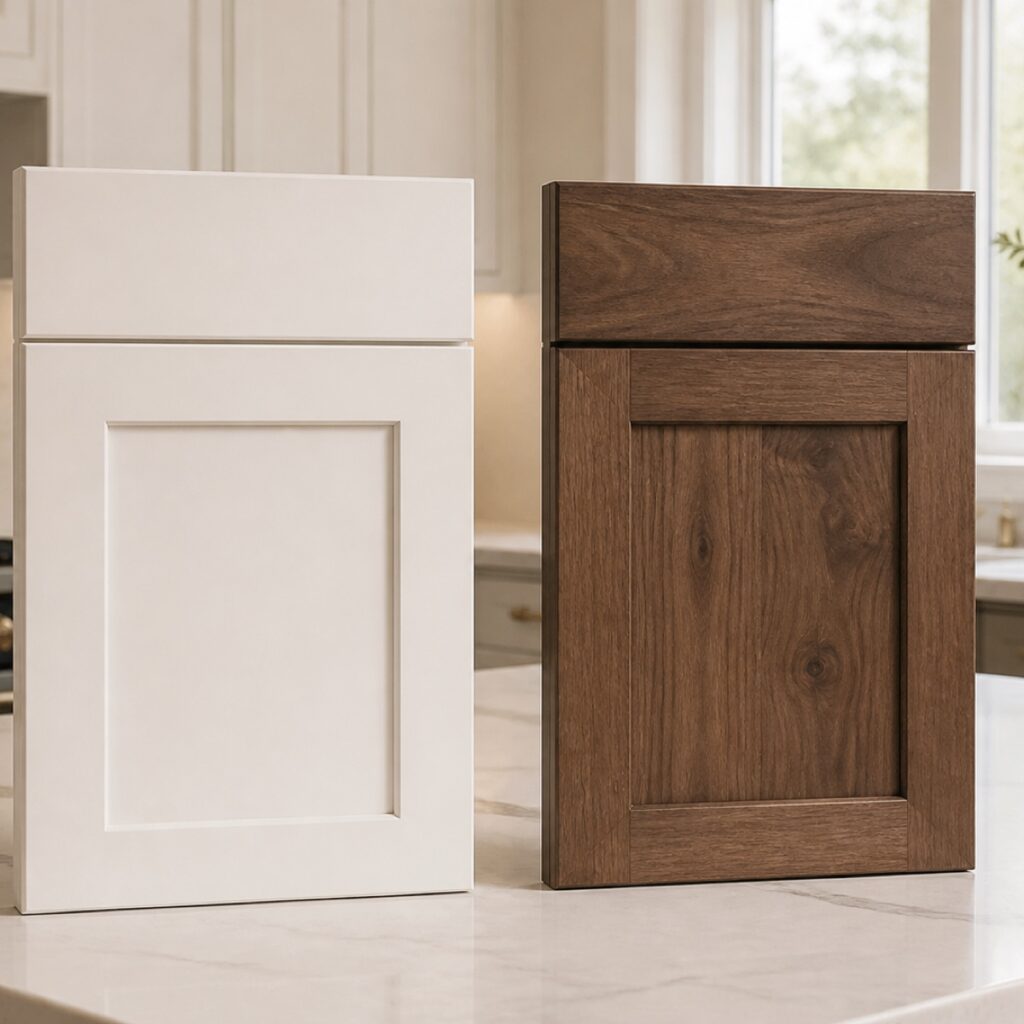
Oak · Paint vs Stain
By ColorUp Cabinets · Published September 30, 2026
Stain when the oak is sound, stain-grade, and you want grain and warmth visible. Paint when you want color leadership — white, greige, or another calm field — and accept that open-grain oak texture may still read under paint. Reface when you need a different door profile or a smoother new surface than painted oak will give.
For the general (any-species) paint-vs-stain fork, start with paint or stain kitchen cabinets. This page is oak-first: open grain, Houston light reading texture, and when fill or reface enters the conversation. ColorUp evaluates the substrate before locking the path.
Stain oak
- Keep grain and warmth visible
- Best when oak is sound and stain-grade
- Color deepens wood character rather than covering it
- Typical kitchen staining range: $4,500–$9,500
Paint oak
- Color leadership: white, greige, or calm field
- Open grain may still read under paint
- Grain fill is a separate decision, not automatic
- Typical kitchen paint range: $3,500–$9,500
Why oak makes the paint-vs-stain choice different
Oak is an open-grain wood. Pores and door-to-door variation are part of how it looks — whether you keep the wood look or move to paint. Stain emphasizes that grain by design. Paint changes color leadership but does not automatically erase texture. Expectation-setting matters more on oak than on smoother maple or MDF.
Builder oak kitchens in Greater Houston often carry an orange or red cast that no longer matches the rest of the house. That color problem can push people toward paint. Wanting the wood character to stay — just quieter or cooler — points toward stain. Hating the door profile itself points past both finishes toward refacing.
Solid oak, oak veneer, and oak-look surfaces
Stain belongs on real wood: solid oak or oak veneer with enough integrity to take color evenly. Oak-look laminate, thermofoil, or plastic skins are not stain paths. Mixed repairs, filler patches, and door-to-door species swaps also limit how even a restain can look. Those conditions belong in the written proposal after assessment — not as a phone quote from a door count alone.
Paint changes color; texture may remain
Open-grain oak can still show pore texture under a well-applied paint system. For the deep dive on how grain reads through paint, see oak grain expectations. For fill vs leave-texture when painting white, see fill oak grain before painting cabinets.
Choose stain (when oak should stay wood)
Lean stain when the oak is sound and stain-compatible, you want natural variation visible, and the goal is a tone shift — not an opaque color field. A cooler brown, a quieter amber, or a clearer topcoat over a carefully chosen stain can reset a dated orange cast without pretending the wood never existed.
Prior finish, heavy patches, and mixed woods affect evenness. ColorUp does not promise a factory-matched restain on every repaired door from a photo alone. The written proposal states species and condition assumptions after review. Service path: wood staining. Planning range for staining: $4,500–$9,500 per /facts/. Deeper cost drivers: cabinet staining cost Houston.
Choose paint (when oak should go color-led)
Lean paint when the oak cast is the problem, boxes and doors are sound, the current door style is still acceptable, and you want a calm color field — white, greige, soft green, or another approved color. Leaving stain behind is also a paint-over path; see paint over stained cabinets.
Expectation: grain may remain visible in side light, especially under Houston daylight and warm evening fixtures. That is normal open-grain behavior, not a coating failure. If you want a smoother painted oak surface, discuss fill as part of scope — link the fill article above; ColorUp does not publish DIY fill recipes.
ColorUp’s painting path uses Renner Italia 2K polyurethane — three coats, AAA airless — with doors typically shop-finished and boxes finished on-site as scoped. Finish comparison vs retail paint: 2K polyurethane vs retail cabinet paint. Shop vs on-site roles: shop-sprayed vs on-site cabinet painting. Planning ranges: most kitchens $3,500–$9,500; usually from $3,500; $2,500 for smaller standalone painting only. Service: cabinet painting.
Paint cannot invent a new door profile
If the oak doors are raised-panel and you want Shaker, painting keeps the geometry. Style change belongs with refacing — see painting cannot change door style.
Decision scorecard
| Condition / goal | Lean stain | Lean paint | Lean reface / refer | Why |
|---|---|---|---|---|
| Want visible grain and wood warmth | Yes on sound oak | No for opaque color leadership | Only if style/boxes fail | Stain keeps grain by design |
| Want uniform light color (white / greige) | Usually no | Yes with texture expectations set | If you also hate the profile | Paint leads color; pores may still read |
| Hate current door profile | No for style change | No for style change | Yes — reface when boxes work | Finish does not change geometry |
| Deep open pores / texture concern | Accept grain as feature | Discuss fill vs leave texture | New doors if smoothness is the real goal | Paint alone does not erase open grain |
| Mixed materials or heavy patches | Caution — evenness may suffer | Often more forgiving for color unity | If doors are beyond keep | Assessment before locking stain |
| Boxes water-failed | No | No | Refer / replace path | Finish needs keepable boxes |
Houston light and oak (no scare claims)
Strong daylight and warm evening fixtures can make remaining oak grain more noticeable after paint. That is lighting context — useful when reviewing samples — not a claim that Houston humidity forces you to paint or forces you to stain. Site condition and design goals still decide.
Review approved samples vertically in the actual kitchen, not only as a flat chip on a table. Side light across open pores is where “will I still see grain?” becomes concrete. Pair that review with oak grain expectations.
Paint vs stain vs reface (cost context)
| Path | Planning range | Oak fit |
|---|---|---|
| Paint | $3,500–$9,500 most (usually from $3,500; $2,500 smaller standalone only) | Color change; texture may remain |
| Stain | $4,500–$9,500 | Sound oak; keep or redirect grain |
| Reface | $5,000–$12,000 | New doors/style or smoother new surface |
ColorUp quotes with a linear-foot / scope method informed by measured run, condition, and finish — without publishing per-door, per-drawer, or per-linear-foot unit rates. Ranges also on cabinet painting cost and cabinet painting vs refacing. Reface service: cabinet refacing.
What a written ColorUp proposal should spell out
A useful oak proposal names species and condition assumptions; whether the recommendation is paint or stain; fill expectations if any; exclusions; warranty years in writing; and schedule after sequence review. Production painting schedules typically land in a 3–5 day window for many kitchens — that is schedule language, not a full-cure calendar.
Doors are typically shop-finished at ColorUp’s Porter shop; boxes are finished on-site as scoped. Brand home: Kingwood 77345. Founded 2021. Greater Houston addresses reviewed before scheduling. Warranty on painting: standard 1 year; 2–3 years with 2K Hardening Agent Upgrade; signed proposal controls. Unsure which service fits? What service do I need.
ColorUp does not install full cabinet replacement. Failed boxes or layout change routes to a custom builder referral — stated on /facts/. Hire questions that surface finish honesty: questions to ask before hiring a cabinet painter.
Frequently asked questions
Is painting oak cheaper than staining?
Planning bands overlap. Most painting: $3,500–$9,500. Staining: $4,500–$9,500. Condition, strip needs, and fill can move either path. The written proposal is the price — not a unit rate.
Can I stain oak white or light?
Very light “whitewash” looks on open-grain oak are specialty finishes with strong expectations around uneven pore take-up. Opaque white color leadership is usually a paint path, not a stain path. Discuss samples in the actual kitchen light.
Can painted oak be stripped back to stain later?
Sometimes, at significant extra labor and with risk to edges and veneer. Plan the finish you want for the medium term rather than treating paint as a reversible experiment.
Does primer hide oak grain?
No. Primer and paint change color; open pores can still read. See oak grain expectations.
When is full replacement needed?
When boxes are soft, swollen, or out of square, or layout must change. ColorUp refers full replacement out; we do not install it. Water-failed boxes also belong on the repair-or-refer track — see water-damaged cabinets: paint, repair, or replace.
Does oak take stain better than paint?
Oak takes stain well when the wood is sound and you want grain visible. “Better” depends on the goal. Stain favors wood character; paint favors color leadership with texture expectations set.
Get an oak paint-or-stain recommendation in writing
ColorUp can review oak doors and boxes in Greater Houston, set grain and color expectations, and put paint, stain, or reface — with planning ranges — on a written proposal.
Request a Cabinet Estimate