Material Guide
By ColorUp Cabinets · Updated September 30, 2026 · Greater Houston
Quartz is a thicker engineered stone (mineral + resin) with fairly consistent pattern and, typically, no sealing — and limited tolerance for hot pans. Porcelain slab, as ColorUp’s catalog describes it, is a thin, printed surface: the pattern is by design, the edge often needs a build-up to look like a full counter, and fabrication rules follow the specified product, including indoor or outdoor rating. ColorUp includes porcelain in the planning library and the service materials list. You still approve a current sample. Price: written proposal after templating — no $/sq ft.
| Quartz | Porcelain slab | |
|---|---|---|
| What it is | Engineered stone | Thin printed high-performance surface |
| Pattern | Through-body / designed look | Printed stone/plaster/mineral directions |
| Edge | Standard stone edge profiles | Often needs edge build-up — scope line |
| Sealing | Typically none | Product-specific; usually low porosity |
| Heat / UV | Trivets; indoor focus | Product-specific — confirm rating |
| Approval | Current sample | Current sample (not a yard “whichever slab”) |
When you compare options, look at finish, edge build-up, fabrication requirements, and indoor or outdoor rating on the exact product you choose. See our countertop catalog.
Edges and waterfalls (high-level)
A porcelain top can be laminated or built up so the edge does not look like a tile. That is a scope line, not a DIY method. A mitered waterfall is possible when the product and the fabrication plan allow it. Because porcelain is printed, the pattern may not wrap the edge perfectly, and we’ll show you what to expect before you approve. See waterfall with painted cabinets. Named ColorUp profiles still apply when the product can take them: eased, beveled, mitered, ogee — confirm on the product.
Painted cabinets and printed pattern
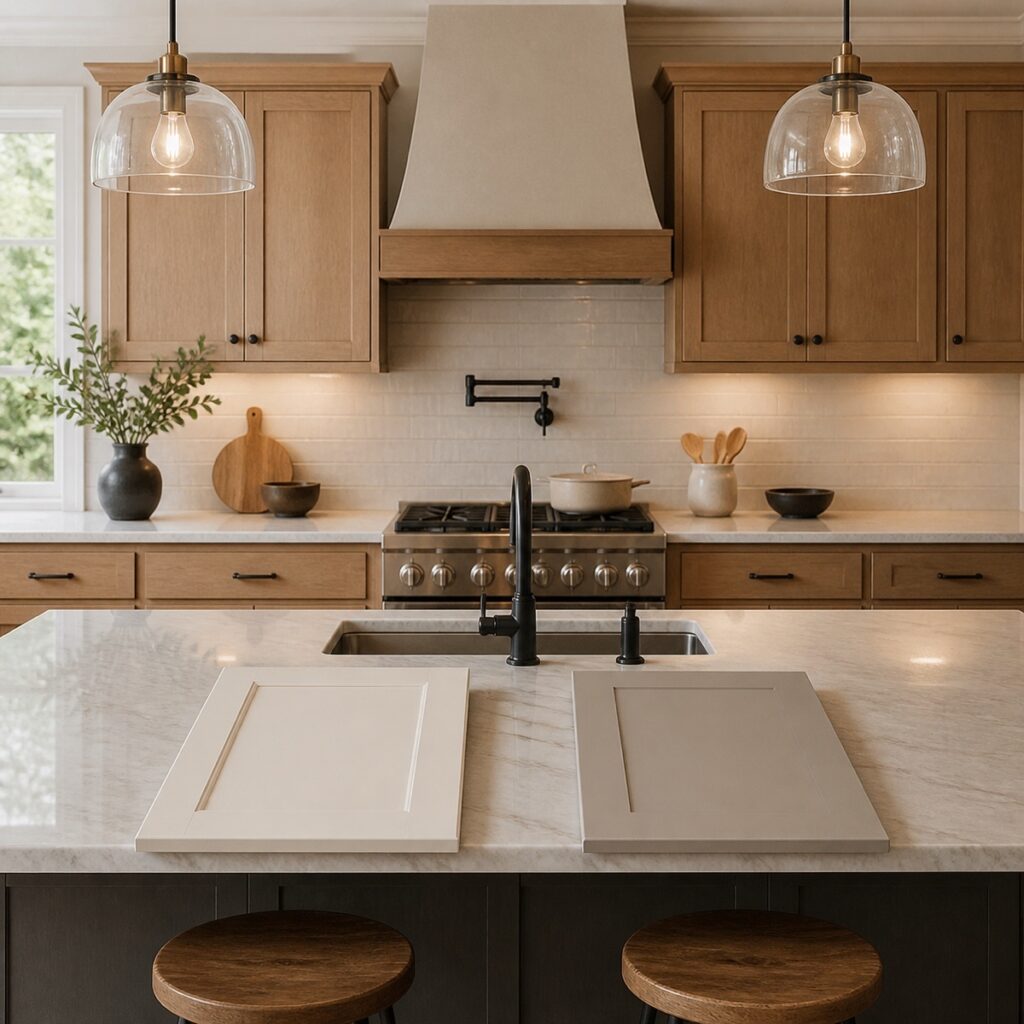
Printed calacatta-style porcelain can be as busy as veined quartz. Quiet cabinet color if the top is loud. Sample door next to the actual porcelain sample in kitchen light. Undertone misses hurt. Guides: busy countertop, plan together.
What not to assume
- “Porcelain never stains, never chips, always outdoors, replaces quartz.” Porcelain can chip at cutouts and edges, so careful fabrication and handling matter. If a chip happens, contact us rather than trying a home repair.
- You may see sintered-stone brands such as Dekton elsewhere. They aren’t part of ColorUp’s catalog; we plan porcelain from the specific products we offer.
- Seams still exist on multi-piece kitchens — seam planning.
ColorUp installs porcelain alongside quartz, quartzite, marble, and granite. You can also replace countertops without painting when your cabinets are in good shape: keep your cabinets.
Frequently asked questions
Does ColorUp install porcelain without painting cabinets?
Yes — counters are stand-alone when cabinets are level and suitable.
Indoor vs outdoor?
Outdoor use depends on the specific product. We confirm its rating before it goes in your scope.
Does it need sealer?
Most porcelain is very low porosity. Follow the care sheet for your specific product, which we give you at handoff.
Is Dekton what ColorUp sells?
No. Dekton is a sintered-stone brand ColorUp doesn’t carry. We plan porcelain from our own catalog and the specific products you approve.
Cost vs quartz?
It depends on the product, edge build-up, cutouts, and slab count. You get a written price in your proposal after templating.
Compare porcelain and quartz from the real sample
ColorUp plans porcelain and quartz for Houston kitchens — edge build-up and product ratings confirmed in the written scope after templating.
Request a Cabinet Estimate